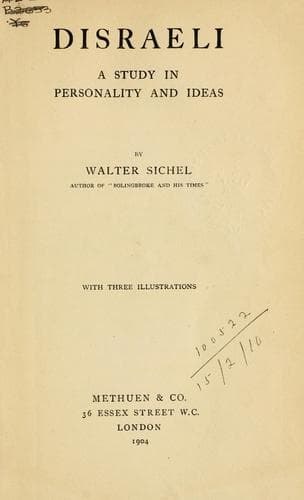
Disraeli: A Study in Personality and Ideas — John Shaqi
Disraeli: A Study in Personality and IdeasSichel, Walter
History
Disraeli: A Study in Personality and Ideas
Sichel, Walter
Disraeli, Benjamin, 1804-1881
It is this idea of personality that lies at the very root of united
nationality; for a nation is an idealised individual, no aggregate
of atoms. Still less is it the experimenting room of doctrinaires
or the dumping-ground of the Tapers and Tadpoles, the Paul Prys of
politics, who “whisper nothings that sound like somethings;” or of
those “Marneys,” “Fitz-Aquitaines,” and “Mowbrays” who deem that the
end of an administration is “two garters to begin with;” or again of
“the good old gentlemanlike times, when Members of Parliament had
nobody to please, and Ministers of State nothing to do;” of those who,
like “Rigby,” mistake peddling with constituencies for representing
the country; or of those petty placemen to whom, as he has said, party
means the machinery for receiving “£1200” a year, career the pursuit of
it, and success its attainment.
“... I prefer” (the passage is from _Sybil_) “association to
gregariousness.... It is a community of purpose that constitutes
society ... without that men may be drawn into contiguity, but they
will continue virtually isolated....” What does this imply but the
sympathetic power of personality? The more individual societies become,
the greater their efficacy. The less individual they are the more they
display the tameness and unfruitfulness that enfeeble a copy.
“But what is an individual,” exclaimed “Coningsby,” “against a vast
public opinion?”
“Divine,” said the stranger. “God made man in His own image; but the
Public is made by newspapers, Members of Parliament, excise officers,
Poor Law guardians. Would Philip have succeeded, if Epaminondas had
not been slain? And if Philip had not succeeded? Would Prussia have
existed, had Frederick not been born? And if Frederick had not been
born? What would have been the fate of the Stuarts, if Prince Henry
had not died, and Charles I., as was intended, had been Archbishop of
Canterbury?”
This was written in 1844. Since then, would Germany have been united
if Bismarck had not been born? And if Bismarck had not been born? In
1865 a powerful party, promising success, reinforced by commanding
talent, and concerting an intelligible plan with immense vigour, began
to demand the disintegration of Great Britain. And if Disraeli had not
been born?----
* * * * *
Public-domain text, read in full here on John Shaqi.
Reviews
Reviews
No reviews yet
Be the first to share your thoughts on this work.
Join the Discussion
Join the discussion
Sign in to leave a comment or review.
Sign InorCreate an account