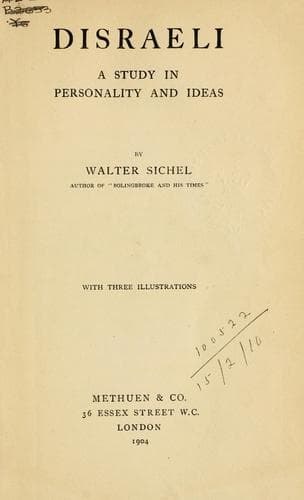
Disraeli: A Study in Personality and IdeasSichel, Walter
History
Disraeli: A Study in Personality and Ideas
Sichel, Walter
Disraeli, Benjamin, 1804-1881
Disraeli’s speech is worthy of close attention, if only because it
forecasts the ultimate federation of South Africa. Disraeli defended
Sir Bartle on the score that to succeed in impugning error, if error
it was, of a distinguished public servant chosen by the Crown, was to
impugn its prerogative. “_Great services are not cancelled by one act
or one single error, however it may be regretted at the moment._ If he
had been recalled ... in deference to the panic, the thoughtless panic
of the hour, in deference to those who have no responsibility in the
matter, and who have not weighed well and deeply investigated all the
circumstances and all the arguments ... which ... must be appealed to
to influence our opinions in such questions--no doubt a certain degree
of odium might have been diverted from the heads of her Majesty’s
ministers, and the world would have been delighted, as it always is,
to find a victim.... We had only one course to pursue, ... to take
care that at this most critical period ... affairs ... in South Africa
should be directed by one, not only qualified to direct them, but who
was superior to any other individual whom we could have selected for
the purpose.”
It would be a bad precedent, he resumed, for the safety of the empire
if an exceptional indiscretion were to efface a long record of signal
ability; and he drew to the recollection of the House[122] the case of
Sir James Hudson at Turin, whose conduct had been similarly attacked,
and whom he, as the leader of the Opposition, had refused to make
a party question, and had himself then defended on the same public
considerations. But adverting to policy, he used these weighty words--
“... Sir Bartle Frere was selected by the noble Lord (Carnarvon) ...
chiefly to secure one great end--namely, _to carry out that policy of_
CONFEDERATION _in South Africa_ which the noble Lord had carried out
on a previous occasion with regard to the North American colonies.
“If there is any policy which, in my mind, is opposed to the policy of
_annexation_, it is that of _confederation_. By pursuing the policy
of confederation, _we bind states together, we consolidate their
resources, and we enable them to establish a strong frontier; that
is the best security against annexation. I myself regard a policy of
annexation with great distrust. I believe that the reasons of state
which induced us to annex the Transvaal were not, on the whole,
perfectly sound._ But what were these circumstances?... The Transvaal
was a territory which was no longer defended by its occupiers.... _The
annexation of that province was ... a geographical necessity._
Public-domain text, read in full here on John Shaqi.
Reviews
Reviews
No reviews yet
Be the first to share your thoughts on this work.
Elsewhere in the archive
Join the Discussion
Join the discussion
Sign in to leave a comment or review.
Sign InorCreate an account