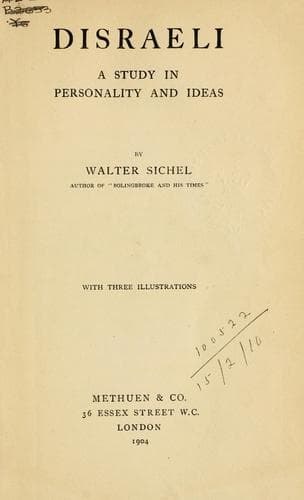
Disraeli: A Study in Personality and IdeasSichel, Walter
History
Disraeli: A Study in Personality and Ideas
Sichel, Walter
Disraeli, Benjamin, 1804-1881
Throughout, his policy was that of confederation, not annexation;
of “scientific frontiers” safeguarding ascertained “spheres of
influence;” of binding, not loosing; of a strong front but a soft
mien; of persuasion, if possible, rather than compulsion--as he always
recommended in framing measures to protect labour and improve society;
of a straight line steadfastly pursued, instead of wobble, worry, and
flurry; first beating the air, and then--a retreat; at once headstrong
and weak-kneed. Although his “Imperialism” was by no means that which
has occasionally since usurped the name, assuredly, in upholding the
burden of Great Britain’s destiny, he would never have recoiled from
“the too vast orb of her fate.” Disraeli’s imperialism was not the
bastard and braggart sort that he once styled “rowdy rhetoric;” nor the
official sort to which he sarcastically alluded when Lord Palmerston,
in 1855, took credit for accepting Lord John Russell’s resignation,
and was “ready to stand or fall by him:” “The noble Lord is neither
standing nor falling, but, on the contrary, he has remained sitting on
the Treasury bench.” Associated with it, lay a deep sense of obligation
in the choice of high character, ability, and spirit to carry it out;
the sense too that a momentary mistake should never sacrifice excellent
proconsuls to the “hare-brained chatter of irresponsible frivolity;”
the resolve also never to shirk responsibility by making scapegoats.
And, beyond all, a feeling that in dealing even with semi-barbarous
nations, it was neither magnanimous, wise, nor dignified to crush them
utterly, and that their feelings, prejudices, and customs ought to be
respected.
Perhaps no better example could be given than his attitude regarding
the events of 1879 in South Africa. The Zulus had threatened and
harassed an impoverished and resourceless Transvaal. The Transvaal had
requested and obtained “annexation” from Great Britain. But the Zulu
chief, irritated by the suppression of the “suzerainty” arrogated by
him over the Boer lands, began to beset the Natal borders. The Governor
of Natal was for appeasing them. Sir Bartle Frere, however, that
commanding High Commissioner of South Africa, took an opposite view,
and favoured a course unmistakable for weakness. In his conferences
with Cetchwayo he made requisitions, on his own initiative, exceeding
his instructions from home. The result was war, with the disaster of
Isandhlwana, the rally of Rorke’s Drift, and eventual success. During
March the matter was brought before the House of Lords in a form
arranged to censure the Government policy, but so worded as to restrict
the debate to the advisability of Sir Bartle Frere’s recall on the
ground of his unauthorised ultimatum.
Public-domain text, read in full here on John Shaqi.
Reviews
Reviews
No reviews yet
Be the first to share your thoughts on this work.
Elsewhere in the archive
Join the Discussion
Join the discussion
Sign in to leave a comment or review.
Sign InorCreate an account