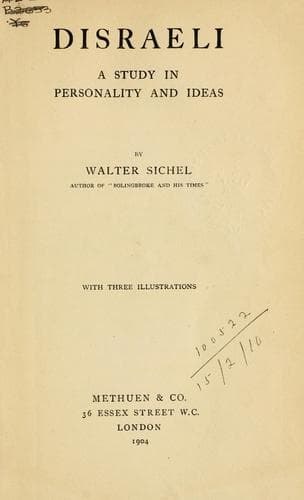
Disraeli: A Study in Personality and IdeasSichel, Walter
History
Disraeli: A Study in Personality and Ideas
Sichel, Walter
Disraeli, Benjamin, 1804-1881
We had, moreover, tampered with the Hindoo religion. “... I think a
very great error exists as to the assumed prejudice of Hindoos with
regard to what is called missionary enterprise. The fact is that ...
the Indian population generally, with the exception of the Mussulmans,
are educated in a manner which peculiarly disposes them to theological
inquiries.... They are a most ancient race; they have a mass of
tradition on these subjects; a complete Indian education is to a
great degree religious; their laws, their tenure of land depend upon
religion; and there is no race in the world better armed at all points
for theological discussion.... Add to this, that they can always fall
back upon an educated priesthood prepared to supply them with arguments
and illustrations.... _But what the Hindoo does regard with suspicion
is the union of missionary enterprise with the political power of the
Government._ With that power he associates only one idea, violence....
It appears to me that the legislative council of India has, under the
new principle, been constantly nibbling at the religious system of the
natives.” It had tried to adapt Western systems to Oriental habits. In
its theoretical system of national education the “sacred Scriptures had
suddenly appeared in the schools; and you cannot persuade the Hindoos
that those holy books have appeared there without the concurrence and
the secret sanction of the Government.” Systematic female education,
again, had been commanded--a most unwise step, considering “the
peculiar ideas entertained by Hindoos with regard to women.” But two
acts had even more contributed to the ferment of native feeling. The
first, that no man who changed his religion should be deprived of his
inheritance. That struck at the main purpose of property in India,
which consists in being a sacred trust for religious objects. The
second, that a Hindoo widow might marry again, “which is looked upon by
all as an outrage on their faith,” uncalled for, and fraught with alarm.
Public-domain text, read in full here on John Shaqi.
Reviews
Reviews
No reviews yet
Be the first to share your thoughts on this work.
Elsewhere in the archive
Join the Discussion
Join the discussion
Sign in to leave a comment or review.
Sign InorCreate an account