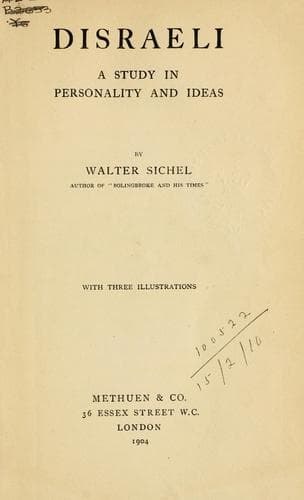
Disraeli: A Study in Personality and IdeasSichel, Walter
History
Disraeli: A Study in Personality and Ideas
Sichel, Walter
Disraeli, Benjamin, 1804-1881
It was signally evinced in his treatment--his exceptional treatment
when Opposition leader--of the Indian Mutiny. At that time Disraeli
alone seemed to grasp the significance of the outbreak in its initial
stage, which was viewed as a mere military rebellion, and regarded as
lightly, and with as little reason, as the beginnings of the Boer War.
“It is remarkable,” he urged, before the crisis became recognised,
“how insignificant incidents at the first blush have appeared which
have proved to be pregnant with momentous consequences. A street riot
in Boston and at Paris, turned out to be the two great revolutions
of modern times. Who would have supposed when we first heard of
the rude visit of a Russian sailor from a port in the Black Sea
to Constantinople, that we were on the eve of a critical war and
the solution of the most difficult of modern problems?” It was, he
contended, a national revolt, not a military mutiny. In our policy of
the immediate past we had forcibly destroyed native authority for the
sole object of increasing revenue. “In spite of the law of adoption,
which was the very corner-stone of Hindoo society, when a native
prince died without natural heirs, though a son had been adopted as
a successor, the Government of India annexed his dominions. Sattara,
Berar, Jeitpore, Sumbulpore, Jhansi, were monuments of ‘nefarious’
acquisition. And Oude, of ‘a wholesale system of spoliation,’ for it
had been annexed even without the pretext of a lawful failure of heirs.”
We had also disturbed the settlement of property by “a new system
of government.” He analysed the popular law of adoption as the
basis of Hindoo property, and as contrasted with its misuse in the
hands of princes as a source of succession. He gave many instances,
distinguishing each. “What man was safe, what feudatory, what
freeholder who had not a child of his own loins, was safe throughout
India?... The Government determined to exact all it could, not only
from princes, but from the people.” The exemptions from the land
tax--“the _whole_ taxation of the State”--had, under pretences, been
continually taken away. The resumption of estates in Bengal alone had
yielded the Government half a million of revenue; in Bombay alone
£370,000 a year. Moreover, hereditary pensions had been commuted into
personal annuities. These disturbances had naturally fomented these
discontents.
Public-domain text, read in full here on John Shaqi.
Reviews
Reviews
No reviews yet
Be the first to share your thoughts on this work.
Elsewhere in the archive
Join the Discussion
Join the discussion
Sign in to leave a comment or review.
Sign InorCreate an account