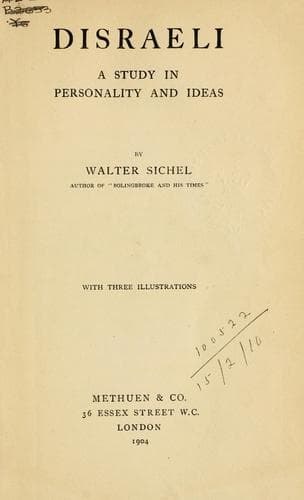
Disraeli: A Study in Personality and IdeasSichel, Walter
History
Disraeli: A Study in Personality and Ideas
Sichel, Walter
Disraeli, Benjamin, 1804-1881
It should be borne in mind that at the time these deliverances were
made Abdul Hamid[129] was not what he seems since to have become.
He was then--and the late Sir William White was my informant--an
enthusiastic reformer, with the wise and accomplished Midhat for his
inspirer. Had he remained so Turkey would have achieved much for
Asia Minor. Even now, Abdul may perhaps be sometimes excused for
mistrusting the cant of reform on the part of unreforming powers.
Perhaps it is impossible long to be Sultan of Turkey without falling
into the faults bred by habitual suspicion. Perhaps the varying
conduct of Western Powers conduces to cynicism. But at this period
the Armenians themselves were hopeful. With the Russian aspiration I
sympathise. Russia is destined to expansion and greatness; she is a
cold power desiring to be warm, pushed by a military power eager to
be forward. But she is also that strange anomaly--a new empire with
a mediæval standard. With the freezing officialism of Russia, giant
in profession and pigmy in practice, I entertain no sympathy at all.
Nor are the Cossack barbarities a whit less infamous than those of
the Bashi-Bazouks. What is always to be dreaded is the periodical
recurrence of race-hatreds and barbarism on the confines of both
countries. Turkey comprises many more races than Russia; at such times,
therefore, when bad governors incense brutalised men, unspeakable
horrors eclipse imagination and baffle even sympathy. Bulgarian or
Servian Slavs massacre Macedonian Greeks, Albanians butcher Macedonian
Serbs, and Turks both massacre and torture Macedonian Slavs. The name
of the particular province inflamed at a specific time by revolutionary
committees is constantly used as if designating the natural uprising
of a united people or of a single race; but this is not the case.
The recent blood-orgy, however, connived at by more than one of the
powers, would seem to disgrace the Ottoman beyond any other single
group concerned. And yet the normal Turk--soldier or peasant--is not
naturally brutal. It is only when insulted fanaticism dements him that
he becomes so; and his fanaticism seldom fans the flames unprovoked
by foreign designs. Of course nothing could be more desirable than
a practical, a permanent understanding with Russia; nothing more
desirable than a complete reform of European Turkey, which the joint
powers could enforce if they would unite. Both are consummations
devoutly to be wished. But bearing in mind the panther tread of Russian
diplomacies, their recent developments in China and Japan, their
constant designs on India and in Persia, their stealthy hankering after
Constantinople, their earlier annexation even of American territory, as
Disraeli pointed out--is the former practical? By all means let Russia
expand, as she has a right to expand; but by all means let England
ascertain the due spheres of her expansion, and retain her own empire,
that gives justice and freedom to countless races once oppressed. Nor
Public-domain text, read in full here on John Shaqi.
Reviews
Reviews
No reviews yet
Be the first to share your thoughts on this work.
Elsewhere in the archive
Join the Discussion
Join the discussion
Sign in to leave a comment or review.
Sign InorCreate an account