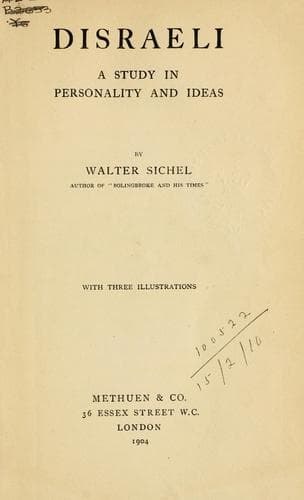
Disraeli: A Study in Personality and IdeasSichel, Walter
History
Disraeli: A Study in Personality and Ideas
Sichel, Walter
Disraeli, Benjamin, 1804-1881
let any cant of whatever nature blind her eyes to the hard issues.
Throughout his pronouncements on foreign affairs is to be discerned his
construction of “balance of power” and of “interference.” As regards
the first, his principles are well defined in a speech of 1864. “...
The proper meaning of ‘balance of power’ is _security for communities_
in general against a predominant and particular power.” It also follows
“that you have to take into your consideration states and influences
that are not to be counted among the European powers.” Every crisis
in Europe bears on America and the colonies. So early as 1848 he had
pointed out that, though insulted, “... yet our welfare as a great
colonial power was so intimately connected with European politics,
that in seasons of crisis we could only retire from interference at
the expense not only of our prestige but of our safety.” The “balance
of power” principle he derived from Bolingbroke; he also adopted from
Bolingbroke his principle of “interference.”
“... There are conditions,” he laid it down in 1860, “under which it
may be our imperative duty to interfere. _We may clearly interfere in
the affairs of foreign countries when the interests or the honour of
England are at stake, or when, in our opinion, the independence of
Europe is menaced._ But a great responsibility devolves upon that
minister who has to decide when those conditions have arisen; and he
who makes a mistake upon that subject, he who involves his country in
interference or in war under the idea that the interests or honour of
the country are concerned, when neither is substantially involved, he
who involves the country in interference or war because he believes the
independence of Europe is menaced, when, in fact, it is not in danger,
makes of course a great, a fatal mistake. _The general principle that
we ought not to interfere in the affairs of foreign nations, unless
there is a clear necessity_, and that, generally speaking, _it ought to
be held a political dogma that the people of other countries should_
SETTLE THEIR OWN AFFAIRS _without the introduction of foreign influence
or foreign power, is one which I trust the House ... will cordially
adhere to_....” To this let me add a passage from the great Denmark
speech of 1864. It is its corollary--
“... By the just influence of England in the councils of Europe, I
mean an influence contradistinguished from that which is obtained by
intrigue and secret understanding; I mean an influence _that results
from the conviction of foreign powers that our resources are great, and
that our policy is moderate and steadfast_.... I lay this down as a
great principle which cannot be controverted in the management of our
foreign affairs. _If England is resolved upon a particular policy, war
is not probable._”
Public-domain text, read in full here on John Shaqi.
Reviews
Reviews
No reviews yet
Be the first to share your thoughts on this work.
Elsewhere in the archive
Join the Discussion
Join the discussion
Sign in to leave a comment or review.
Sign InorCreate an account