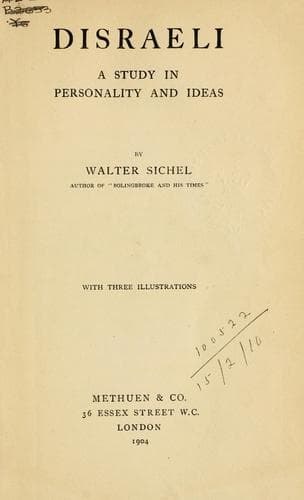
Disraeli: A Study in Personality and IdeasSichel, Walter
History
Disraeli: A Study in Personality and Ideas
Sichel, Walter
Disraeli, Benjamin, 1804-1881
It is not a little remarkable that this farewell re-echoes the
sentence quoted in my first chapter from his tract _What is he?_ as
well as that later Runnymede Letter which, forty years earlier, he
addressed to Sir Robert Peel.[134]
“... Spread it then,
And let it circulate through every vein
Of all your empire; that where Britain’s power
Is felt, mankind may feel her mercy too.”
CHAPTER VII
AMERICA--IRELAND
I have associated these two heads of discussion because they have long
been coupled in home politics, at times disastrously, but now, it may
be hoped, under favouring auspices. On the lighter side of American
society and its first invasions of England he also touched. I shall
touch these in the next chapter, reserving this for the political
aspects of the question. My first chapter has already mentioned the
paragraph in his earliest pamphlet, dedicated to Canning.
Disraeli was always intensely interested in America, and watched her
development with vigilance. He predicted her imperial future. He
deprecated jealousy of her power, and, while England was incensed
at her conduct in 1871, he alone maintained that it was due to
the prejudices of a class and the objects of a party, not to the
national sentiment. He descried in America’s essential democracy,
which adheres even to her republican forms, one wholly peculiar to
herself--a democracy of the soil, of which the base and root is land,
underlying the gigantic commerce and colossal finance which are merely
the froth of her wealth; and in such a democracy he perceived an
element of stability lacking to every other known democratic country.
Before her crucial conflict was determined, he prophesied, too, among
the difficulties that must confront her, that of a vast number of
emancipated negroes. When the great struggle arose between the energy
of the North and the traditions of the South, Disraeli also, alone
among the leaders of his party, discerned both the probabilities of
the winning side and its aptitude for moderation and self-control.
For this sagacity he received Mr. Bright’s approbation in 1865. When
the civil war was in process, the gentry of England, naturally and
generously sympathetic with the Southerners, had suspected that Canada
might be threatened, and had wished something “to be done;” Disraeli
restrained and allayed them. Mr. Bright said: “With a thoughtfulness
and statesmanship which you do not all acknowledge, he did not say a
word from that bench likely to create a difficulty with the United
States. I think his chief and his followers might learn something from
his example.” I quote this meed from an opponent, because Mr. Bryce,
in his recent monograph, implies the contrary; but then, Mr. Bryce
sometimes trips, and has made the trifling mistake of naming “Lucian”
as Disraeli’s pet classic, whereas surely it was “Tacitus.”
Public-domain text, read in full here on John Shaqi.
Reviews
Reviews
No reviews yet
Be the first to share your thoughts on this work.
Elsewhere in the archive
Join the Discussion
Join the discussion
Sign in to leave a comment or review.
Sign InorCreate an account