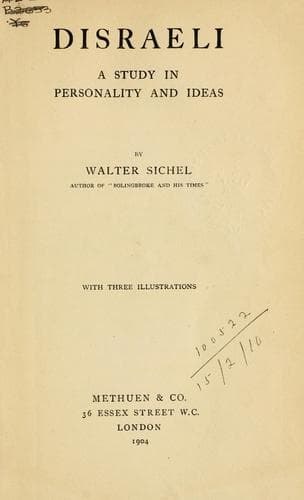
Disraeli: A Study in Personality and IdeasSichel, Walter
History
Disraeli: A Study in Personality and Ideas
Sichel, Walter
Disraeli, Benjamin, 1804-1881
Disraeli’s leading idea as to America was that, although she had long
achieved independence, her original spirit had remained colonial,
but that her civil war would transform the past colony into a coming
empire. Speaking in 1863, he said--
“I am bound to say that from the first--and subsequent events have
only confirmed my convictions--I have always looked upon the struggle
in America in the light of a great revolution.[135] Great revolutions,
whatever may be their alleged causes, are not likely to be commenced,
or to be concluded, with precipitation. _Before the civil war
commenced, the United States were colonies_, because we should not
forget that such communities do not cease to be colonies because they
are independent. _They were not only colonies, but colonising_; and
they existed under all the conditions of colonial life except that
of mere political dependence. _But even before the civil war_, I
think that all impartial observers must have been convinced that in
that community _there were smouldering elements which indicated the
possibility of a change, and perhaps of a violent change_. The immense
increase of population; the still greater increase of wealth; the
introduction of foreign races in large numbers as citizens, not brought
up under the laws and customs which were adapted to a more limited,
and practically a more homogeneous, race; the character of the
political constitution, consequent, perhaps, on these circumstances;
_the absence of any theatre for the ambitious and refined intellects
of the country, which deteriorated public spirit and lowered public
morality_; and, above all, _the increasing influence of the United
States upon the political fortunes of Europe_;--these were all
circumstances which indicated _the more than possibility that the mere
colonial character of these communities might suddenly be violently
subverted, and those imperial characteristics appear which seem to
be the destiny of man_. I cannot conceal from myself the conviction
that, whoever in this House may be young enough to live to witness
the ultimate consequences of this civil war, will see, whenever the
waters have subsided, a different America from that which was known
to our fathers, and even from that of which this generation has had
so much experience. _It will be an America of armies, of diplomacy,
of rival states and manœuvring cabinets, of frequent turbulence, and
probably of frequent wars._ With these views, I have myself, during the
last session, exerted whatever influence I possessed in endeavouring
to dissuade my friends from embarrassing her Majesty’s Government in
that position of politic and dignified reserve which they appeared to
me to have taken upon this question. It did not appear to me, looking
at these transactions across the Atlantic, _not as events of a mere
casual character, but being such as might probably influence, as the
great French Revolution influenced, and is still influencing, European
Public-domain text, read in full here on John Shaqi.
Reviews
Reviews
No reviews yet
Be the first to share your thoughts on this work.
Elsewhere in the archive
Join the Discussion
Join the discussion
Sign in to leave a comment or review.
Sign InorCreate an account