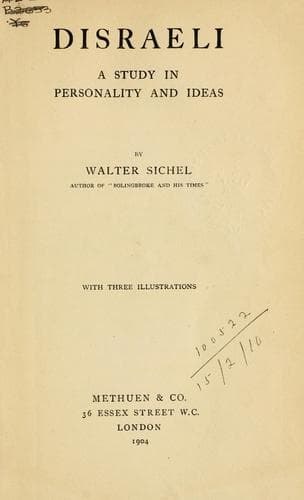
Disraeli: A Study in Personality and IdeasSichel, Walter
History
Disraeli: A Study in Personality and Ideas
Sichel, Walter
Disraeli, Benjamin, 1804-1881
Such were the elements of disunion. To cope with them a strong
government was requisite; and that meant a _centralising_ government
with a military force at its command to uphold unity and order. Our
colonies, on the other hand, were free from such obstacles, and were
themselves developing an “element of nationality.” They would not be
assailed. But none the less, we must reckon with the United States
in “the balance of power.” He would not say that a class in America
regarded old Europe “with feelings of jealousy or vindictiveness,” “...
but it is undeniable that the United States look to old Europe with _a
want of sympathy. They have no sympathy with a country that is created
and sustained by tradition._” We must, therefore, for the far future,
foster and defend our colonies. If Canada had preferred absorption
by America, “... we might terminate our connection with dignity, and
without disaster.” But if, as appeared, Canada and our North American
colonies desired deeply and sincerely “to form a considerable state
and develop its resources, and to preserve the patronage and aid of
England, ... then it would be the greatest political blunder that
could be conceived, for us to renounce, relinquish, and avoid the
responsibility of maintaining our interests in Canada.”
American Anglophobia once more engaged his attention in 1871. The pith
of his criticism may be summarised by the purport of that elegant
metaphor, “Twisting the lion’s tail.” With regard to the _Alabama_
claims, their “indirect” demands, and the disputes with our colonies,
which once more provoked British feeling, Disraeli now complained that
America’s communications with England had been couched in arrogant
terms, while those with Russia and Germany had been courteous.
He declared that it was caused by rowdy rhetoric addressed to
“irresponsible millions.” “... The reason of this offensive conduct,”
he continued, “is this: there is a _party_ in America, _who certainly
do not monopolise the intelligence, education, and property of the
country, and who, I believe, are not numerically the strongest, who
attempt to obtain political power and excite political passion by
abusing England and its Government, because they believe they can
do so with impunity_.... The danger is this. Habitually exciting the
passions of millions, some unfortunate thing happens, or something
unfortunate is said in either country; the fire lights up, it is beyond
their control, and the two nations are landed in a contest which they
can no longer prevent.... Though I should look upon it as the darkest
hour of my life, if I were to counsel, or even to support, a war with
the United States, still, the United States should know that they are
not an exception to the other countries of the world, that we do not
permit ourselves to be insulted by any other country in the world, and
that they cannot be an exception.” Nevertheless, with regard to these
Public-domain text, read in full here on John Shaqi.
Disraeli: A Study in Personality and Ideas — John Shaqi
Reviews
Reviews
No reviews yet
Be the first to share your thoughts on this work.
Elsewhere in the archive
Join the Discussion
Join the discussion
Sign in to leave a comment or review.
Sign InorCreate an account