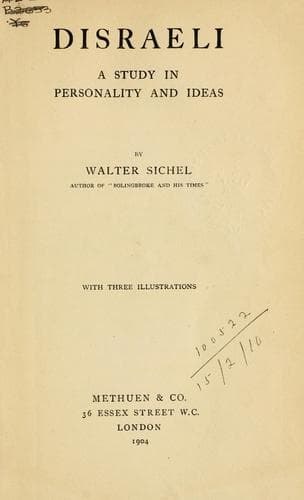
Disraeli: A Study in Personality and IdeasSichel, Walter
History
Disraeli: A Study in Personality and Ideas
Sichel, Walter
Disraeli, Benjamin, 1804-1881
very matters, he reiterated as late as 1872: “Ever since I sat in this
House, I have always endeavoured to maintain and cherish relations of
cordiality and confidence between the United Kingdom and the United
States. I have felt that between those two great countries the material
interests were so vast, _were likely so greatly to increase_, and were
in their character so mutually beneficial to both countries, that
they alone formed bonds of union.... But I could not forget that,
in the relations between the United States and England, _there was
an element also of sentiment_, which ought never to be despised in
politics, and without which there can be no enduring alliance. When
the unhappy Civil War occurred, I endeavoured, therefore, so far as I
could, to maintain ... a strict neutrality between the Northern and
the Southern states.... There were some at a particular time ... who
were anxious to obtain the recognition of the Southern states by this
country. I never could share that opinion.... We were of opinion that,
had that recognition occurred, it would not have averted the final
catastrophe, ... and it would, at the same time, have necessarily
involved this country in a war with the Northern states, _while there
were circumstances then existing in Europe which made us believe that
the war might not have been limited to America_.”
I must now consider Fenianism. Every one now knows that Fenianism,
at its inception in 1865, though its pretext was Ireland and its
rallying centre America, was really an _international_ ruffianism for
the disruption of the foundations of social order--was, in fact, an
alliance of anarchists with soldiers of misfortune. Disraeli discerned
this from the first. Plots and conspiracies of all kinds piqued at once
his curiosity, his skill, and his fancy. I was told, more than thirty
years ago, by an old gentleman who was a schoolfellow of Disraeli,
that he remembered a boyish mutiny. Disraeli headed the conspiracy,
and the head-master himself listened at the keyhole, spellbound by the
eloquence that controlled it. He loved to unravel their machinations,
to contrast their underground conclaves with their open appearance.
Conspiracies abound in _Vivian Grey_, _Alroy_, _Iskander_, _Contarini
Fleming_, _Sybil_, and _Tancred_; these very secret societies, together
with those of Jesuitry, pervade _Lothair_. “Mirandola” and “Captain
Bruges” are drawn from life. When Fenianism raged in Ireland, Disraeli
himself crossed the Channel and attended their meetings. He spoke
about what he knew; and if secret societies were his hobby, he was yet
undoubtedly right in ascribing most of the unforeseen abroad to their
initiation.
Public-domain text, read in full here on John Shaqi.
Reviews
Reviews
No reviews yet
Be the first to share your thoughts on this work.
Elsewhere in the archive
Join the Discussion
Join the discussion
Sign in to leave a comment or review.
Sign InorCreate an account