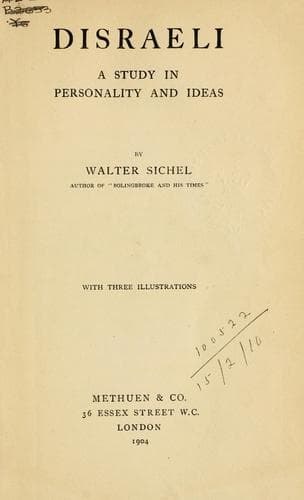
Disraeli: A Study in Personality and IdeasSichel, Walter
History
Disraeli: A Study in Personality and Ideas
Sichel, Walter
Disraeli, Benjamin, 1804-1881
sham banners of St. Joseph and harangued by a mock priest, “They manage
their affairs in general wonderfully close, but I have no opinion of
them. I have just returned from Ireland, where I thought I would go
and see what they really are after. No real business in them. Their
treason is a fairy tale, and their sedition a child talking in its
sleep.”
* * * * *
And this brings me to Disraeli’s ideas concerning the romantic, the
persecuted, the generous, the witty, the pathetic Ireland.
No one who has studied his career can question his intense sympathy.
Many of his earliest friends had been brilliant Irishmen and
Irishwomen. He too sprang from a race once persecuted, still pathetic,
always witty and romantic. Already, in 1843, Disraeli had exclaimed:
“You must reorganise and reconstruct the Government, and even the
social state of Ireland.... By really penetrating into the mystery of
this great misgovernment” might be brought about “a state of society
which would be advantageous both to England and Ireland, and which
would put an end to a state of things that was the bane of England
and opprobrium of Europe.” But his ideas are conspicuously set forth
in the great speech of 1844, which won the high praise of Macaulay,
which Mr. Gladstone, some quarter of a century later, described as
one of the “most closely woven tissues of argument and observation
that had ever been heard in the House,” and the reperusal of which
he recommended as an intellectual “treat;” though Disraeli himself
then ironically observed that when he delivered it, nobody appeared
to listen. “It seemed to me that I was pouring water upon sand, but
it seems now that the water came from a golden goblet.” He showed
that, politically, Ireland was an open question. It was not the
Tories who started the penal code. Mr. Pitt would have settled the
question long ago had not the great war diverted his policy. Again,
the grievances of Ireland were not due to Protestantism. They were
owing to Puritanism--Puritanism in disloyal rebellion against which
loyal Ireland rebelled. Ireland, he proved, was never so contented
as in 1635. There was then perfect civil and religious equality. “At
that period there was a Parliament in Dublin called by a Protestant
king, presided over by a Protestant viceroy, and at that moment there
was a Protestant Established Church in Ireland; yet the majority of
the members of that Parliament were Roman Catholics. The government
was at that time carried on by a council of state presided over
by a Protestant deputy, yet many of the members of that council
were Roman Catholics. The municipalities were then full of Roman
Catholics. Several of the sheriffs also were Roman Catholics, and a
very considerable number of magistrates were Roman Catholics. _It is,
therefore, very evident that it is not the necessary consequence of
English connection--of a Protestant monarchy, or even of a Protestant
Public-domain text, read in full here on John Shaqi.
Reviews
Reviews
No reviews yet
Be the first to share your thoughts on this work.
Elsewhere in the archive
Join the Discussion
Join the discussion
Sign in to leave a comment or review.
Sign InorCreate an account