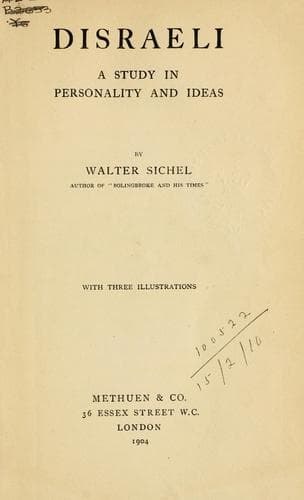
Disraeli: A Study in Personality and IdeasSichel, Walter
History
Disraeli: A Study in Personality and Ideas
Sichel, Walter
Disraeli, Benjamin, 1804-1881
Adverting, in 1872, to its fatal influence on Ireland, he remarked:
“... The Civil War in America had just ceased, and a band of military
adventurers, Poles, Italians, and many Irishmen, concocted at New York
a conspiracy to invade Ireland, with the belief that the whole country
would rise to welcome them. How that conspiracy was baffled ... I
need not now remind you.... You remember how the constituencies were
appealed to, to vote against the Government who had made so unfit an
appointment as that of Lord Mayo to the Viceroyalty of India. It was by
his great qualities when Secretary for Ireland, by his vigilance, his
courage, his patience, and his perseverance, that this conspiracy was
defeated. He knew what was going on at New York, just as well as what
was going on in the city of Dublin?...” And when, only a year before,
the then Lord Hartington, at a moment of Fenian resurrection, withdrew
his motion for a secret committee, Disraeli inveighed against an
indecision that would be flashed in an hour across the Atlantic. This
new movement of Fenianism brought America into dangerous relations
with England. And in many disguises and under mitigated forms, it half
associated itself with the agitation for repeal, and the restless
intrigues of the Papacy. Paid Nationalists and peasant priests were
brought into connection with these Swiss guards of treason, ready to
compass the destruction of property and authority in any country, and
for any cause. It had been otherwise before its invention in America.
When O’Connell--the great O’Connell as, despite everything, Disraeli
publicly confessed when he died--supported Disraeli (who began as an
“Independent”) at his first election in 1832, he did so on the common
ground that both abominated the Whig system and desired the extension
of reform. It was only afterwards, when O’Connell pronouncedly lent
himself to what tended towards a repetition of “Captain Rock,” and
became at once an agitator for dismemberment[137] and a pillar of the
Whigs, that the young Disraeli denounced the fellowship of the dagger
with the mitre, and incensed the degenerating patriot into insult. But
the violence in Ireland of O’Connell’s days was native. It sprang from,
and it disgraced, the soil. Fenianism, however, added to the ancient
terrors of a country distressed to madness and goaded into crime, the
worst horrors of cosmopolitan conspiracies mated with every movement
for the unsettlement of Europe; and for a while it tainted every breath
of Irish nationalism, not only with detestation of England, but with
enthusiasm for her enemies. The “Clan-na-gael” still foments the last
vestiges of genuine discontent; but the headquarters seem to have
shifted from New York to a European capital. And yet so unconcerted and
unprepared was Ireland herself, however equipped and compact were these
mercenary foreigners, that Disraeli makes “Captain Bruges” exclaim in
_Lothair_, after his rescue of the hero at the meeting, held under the
Public-domain text, read in full here on John Shaqi.
Reviews
Reviews
No reviews yet
Be the first to share your thoughts on this work.
Elsewhere in the archive
Join the Discussion
Join the discussion
Sign in to leave a comment or review.
Sign InorCreate an account