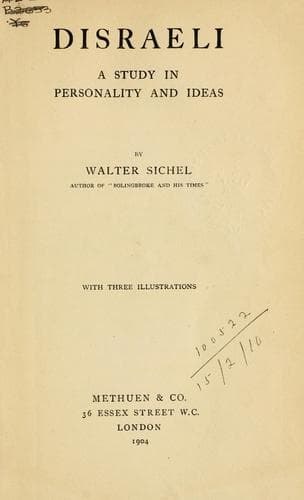
Disraeli: A Study in Personality and IdeasSichel, Walter
History
Disraeli: A Study in Personality and Ideas
Sichel, Walter
Disraeli, Benjamin, 1804-1881
“... What, then, is the duty of an English minister? _To effect by his
policy all those changes which a revolution would do by force...._ It
is quite evident that, to effect this, we must have an Executive in
Ireland which shall bear _a much nearer relation to the leading classes
and characters_ of the country than it does at present. There must
be a much more _comprehensive_ Executive, and then, having produced
order, the rest is a question of time. There is no possible way by
which the physical condition of the people can be improved by Act of
Parliament.”[139]
So I read this pregnant deliverance. So, I believe, will read it any
one who scans it closely in relation to its time and setting. In
1868, when there was capital to be made out of it, Mr. Gladstone did
not so read it. Mr. Gladstone contended--and he had full right to
contend--that, with regard to the Church, at any rate, it spelled out
“Destruction.” Disraeli contented himself with retorting: “... There
are many remarks which, if I wanted to vindicate ... myself, I might
legitimately make.... But I do not care to say it, and I do not wish
to say it, because in my conscience the _sentiment of that speech
was right_....” My view is that it spelled out “Reconstruction.” It
would have settled Ireland and the Irish question by the principles of
1636 and on the lines of 1792, and not either by the Orange lodges of
1795, which answered Pitt’s abortive schemes of improvement, or by the
undemanded spoliation of 1868, which trebled the discontent it designed
to allay. All Pitt’s proposed measures were against _exclusion_.
He tried to grant Ireland that free outlet for her manufactures to
England which had proved her main source of discontent throughout the
eighteenth century. He tried to include the Protestant Dissenters as
well as the Roman Catholics in the avenues to political power. He was
foiled by the selfishness and corruption of an Irish caste, and by
the spread of the French Revolution to the Irish multitude. But in
each case _inclusion_ was his principle; development, not destruction.
Disraeli followed him. It was his hatred of exclusiveness that prompted
his aversion alike to the Whiggism of the Grenvilles and the Toryism of
Eldon. It was his devotion to wide and popular as opposed to democratic
and class principles that drew him to the Toryism of Bolingbroke and
Wyndham, and enabled him to reconstruct the Tory party on its first but
forgotten foundations.
Public-domain text, read in full here on John Shaqi.
Reviews
Reviews
No reviews yet
Be the first to share your thoughts on this work.
Elsewhere in the archive
Join the Discussion
Join the discussion
Sign in to leave a comment or review.
Sign InorCreate an account