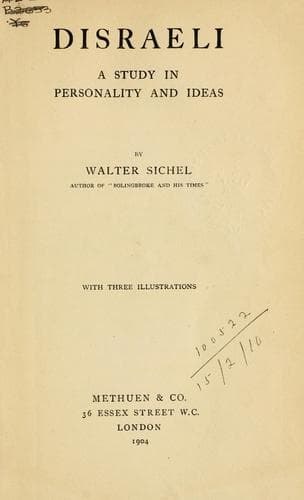
Disraeli: A Study in Personality and IdeasSichel, Walter
History
Disraeli: A Study in Personality and Ideas
Sichel, Walter
Disraeli, Benjamin, 1804-1881
But if we want a practical comment on the speech of 1844, we have it
in an utterance of 1868. In 1868 he defined the position: “... I said
the other night, as I say now, that I think you might elevate the
_status_ of the unendowed clergy in Ireland.... My opinion is, that if
this system of conciliation, founded on the principle that in Ireland
_you ought to create and not destroy_, had been pursued, you might have
elevated the Irish Church greatly to its advantage. You might have
rendered it infinitely more useful.... I do not think it impossible
that you might have introduced measures which would have elevated
the _status_ of the unendowed clergy, and so softened and terminated
those feelings of inequality which now exist, _so that you might
have had the same equality in the state of Ireland which you have in
England_. There is perfect equality in the state of the Dissenter in
England, although his is no established Church. That state of things
might exist in Ireland, if you had taken measures which would, among a
sensitive people, have prevented a sentiment of humiliation.... Without
disestablishment, without the difficulties and dangers of concurrent
endowment, there might have been a system of Government grants both
to Romanists and Dissenters for education and other public objects.
That is how I interpret the ‘ecclesiastical equality’ of 1844; ‘to
create and not to destroy.’”[140] And, speaking again of his desire to
supplement the educational means for the Roman Catholics, he said: “...
That is in accordance with our uniform policy, ... a reconciliation
between creeds and classes.”
Public-domain text, read in full here on John Shaqi.
Reviews
Reviews
No reviews yet
Be the first to share your thoughts on this work.
Elsewhere in the archive
Join the Discussion
Join the discussion
Sign in to leave a comment or review.
Sign InorCreate an account