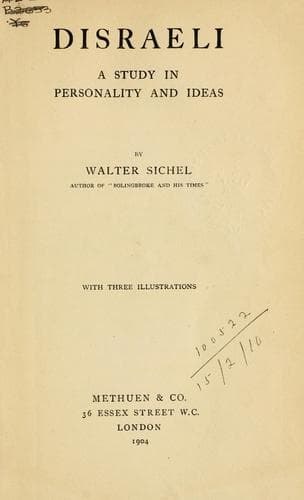
Disraeli: A Study in Personality and IdeasSichel, Walter
History
Disraeli: A Study in Personality and Ideas
Sichel, Walter
Disraeli, Benjamin, 1804-1881
Time went on. Ireland had improved by rest. There was even
prosperity in her borders. Fenianism was subsiding.[142] Classes
were less estranged. Emigration had increased, but the Liberals
welcomed emigration. Disraeli had risen into supreme power, and had
constitutionalised the democracy by his Bill of 1867. The Radicals were
incensed at the measure, which they had coveted in another form and
with sectional objects. The stiffer even of his own party stood aghast,
and some seceded. The Liberals began to nibble at the Radical bait. It
is a curious fact that the Whigs, when in political despair, usually
resort to a revolutionary measure. Already, over thirty years before,
they had done so in connection with Ireland. Suddenly, without warning,
without a popular mandate, or even an Irish outcry for the upheaval,
like a bolt from the blue came Mr. Gladstone’s first great conversion
from principles firmly protested only a year before.[143] The question
was sprung on both countries. He brought in, and in a manner so
imperious that a solid portion of his own followers deserted him, his
Act for the Disestablishment and Disendowment of the Irish Church; not
only for its severance from the State, but for its spoliation by the
State.
In the abstract its disestablishment, apart from its disendowment,
was a great, a just, and a generous measure; theoretically it was as
sound as bimetallism. But its logical issues were incompatible with a
united kingdom. They really, on examination, involved that separatist
theory of the “right” of “nationalities” to be self-governing, of
which he grew so fond. “Nationality” is here a wrong expression, for
“nationality” is, by its essence, a term of union, and not of division.
It should be “Locality.” What is meant by this assumed “right” is, that
particular races or particular provinces, absorbed into or dependent on
“nationalities,” are entitled, from the mere fact of their geographical
limits, to withdraw from the greater whole of which they are portions.
This theory would revive the Heptarchy. It would make Jersey and
Guernsey, or the Isle of Man, it would make Scotland or Wales, a
“nation.”
Public-domain text, read in full here on John Shaqi.
Reviews
Reviews
No reviews yet
Be the first to share your thoughts on this work.
Elsewhere in the archive
Join the Discussion
Join the discussion
Sign in to leave a comment or review.
Sign InorCreate an account