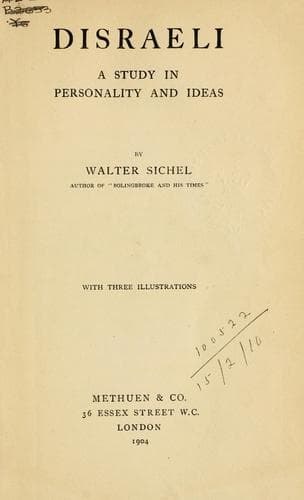
Disraeli: A Study in Personality and IdeasSichel, Walter
History
Disraeli: A Study in Personality and Ideas
Sichel, Walter
Disraeli, Benjamin, 1804-1881
After 1844 the Irish question still festered. Nowhere did the repeal
of the Corn Laws inflict more immediate distress than in a country so
dependent on native agriculture as Ireland was then and still remains.
Pauperism became the crying evil of Ireland. Even in 1869, more than a
quarter of the inhabitants were paupers. Pauperism defied “political
palliatives.” The Government of Ireland, despite his warnings, remained
a weak one, and, alluding to this in a famous speech of 1869, he
pertinently brought into prominence the fact that what strength it
has depends now on its connection with England. “... The Government
of Ireland is not a strong one; its sanctions are less valid than
those of the Government of England. It has not the historic basis
which England rests upon. It has not the tradition which the English
Government rests upon. It does not depend upon that vast accumulation
of manners and customs which in England are really more powerful than
laws or statutes.” What Disraeli felt all along was that Ireland
needed security for capital and variety of employment; and that for
these repose and order were requisite. In November, 1868, alluding
to the naturalisation of Fenianism in Ireland at a time when Ireland
was inherently contented and immeasurably superior to her plight in
1844--when she had begun to rest and be thankful--he made the following
comment:--
“... In Ireland there was always a degree of morbid discontent which
the Fenians believe they may fan into flame, and which might lead to
the revolutionary result they desire. The whole nature of the race
will account for it. An Irishman is an imaginative being. He lives in
an island, in a damp climate and contiguous to the melancholy ocean.
_He has no variety of pursuit._ There is no nation in the world that
leads so monotonous a life as the Irish, because _their only occupation
is the cultivation of the soil before them_.... The Irishman in other
countries, _where he has a fair field for his talents in various
occupations, is equal, if not superior, to most races_.... I may say
with frankness that I think this is the fault of the Irish. If they
led that kind of life which would invite the introduction of capital
into the country, all this ability might be utilised; and instead of
those feelings which they acquire by brooding over the history of
their country, a great part of which is merely traditionary, you would
find men acquiring fortunes, and arriving at conclusions on politics
entirely different from those which they now offer.”
The same outlook prompted him in another speech to regret the cry of
a “conquered people” which the manipulators of grievance perpetually
raised. Ireland was no more a conquered country than England. In both
there had been conquerors and conquests;[141] but in both a blend of
races and institutions which had produced a nation in one, and made for
nationality in the other.
Public-domain text, read in full here on John Shaqi.
Reviews
Reviews
No reviews yet
Be the first to share your thoughts on this work.
Elsewhere in the archive
Join the Discussion
Join the discussion
Sign in to leave a comment or review.
Sign InorCreate an account