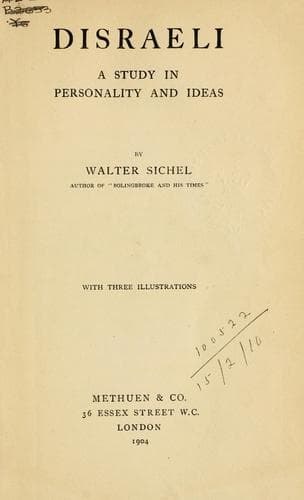
Disraeli: A Study in Personality and IdeasSichel, Walter
History
Disraeli: A Study in Personality and Ideas
Sichel, Walter
Disraeli, Benjamin, 1804-1881
He objected to it on principle--the principles outlined in my second
chapter. The union of Church and State is a symbol of the Divine nature
of government, which is the only truth underlying the obsolete fiction
of the “Divine Right of Kings.” He objected to it on policy. Divorce
the religious principle from that of government, and it is the State
that will suffer most. The result must be disorder. One day that might
take a peculiar form. The political power once separated from the
spiritual, a crisis might arise where the two might collide; and where,
though the political power might be right, the spiritual would appeal
in haste to both passion and prejudice.
As regards the _Disendowment_.
He objected to it on principle. The plunder of public corporations was
nothing new, but where the trust for which the corporation had been
endowed was not observed in the application of the spoil by the State,
which was a trustee, it was indefensible. It became confiscation.
“Irish purposes” were vaguely hinted as the destination, but the repeal
of the whisky duty might be an “Irish purpose;” and where was the sense
of dedicating some of this annexed property to Irish pauper lunatics?
Moreover, historically, he had always noticed that the spoil of the
Church went eventually to enrich the large landed proprietors.
He objected to it on policy. One of the causes of discontent was
alleged to be that a particular Church was not connected with the
State. Mr. Gladstone proposed to regenerate the country by having
_three_ Churches not connected with the State. Discontent, however,
would still remain smouldering, and Disraeli prophesied that its next
phase would threaten the tenure of land. What would be the effect in
this relation of having three Churches disconnected from the State? The
land question would, he predicted, assume many threatening forms with
one purpose--a purpose against the rights and the duties of property.
One Church was to be deprived of property which none of the others
claimed. Three sets of clergy were to be equally apart from the State.
A class in the first place, therefore, and that a class of resident
proprietors, was to be destroyed; when it was agreed that one of the
evils in Ireland was the want of a variety of classes and of resident
proprietors. In the second, one of the avowed evils, the curse of
Ireland, was poverty; but here was an Act to confiscate property, and
that property in its nature popular--the appanage of the people.
Public-domain text, read in full here on John Shaqi.
Reviews
Reviews
No reviews yet
Be the first to share your thoughts on this work.
Elsewhere in the archive
Join the Discussion
Join the discussion
Sign in to leave a comment or review.
Sign InorCreate an account