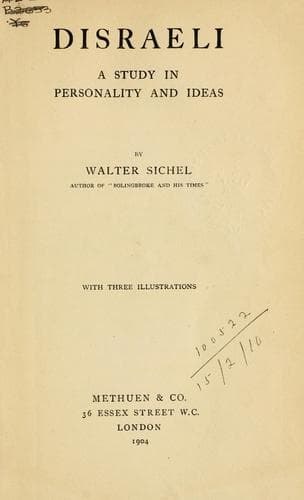
Disraeli: A Study in Personality and IdeasSichel, Walter
History
Disraeli: A Study in Personality and Ideas
Sichel, Walter
Disraeli, Benjamin, 1804-1881
When the land question should arise, there might ensue a triple danger,
that of three sets of clergy divided in theology and matters of
discipline, but united in discontent; and the three might eventually
demand the restoration of the national property; and if it were
refused, there might be revolution. England could afford no more
revolutions. But, in any case, the spoliation of the Protestant clergy
would breed jealousies among themselves also; for they were actually
invited and induced (by means which he exposed) to co-operate in their
own expropriation. The plunder of the Catholic clergy had bred great
discontent. The plunder of the Protestant clergy would do the same.
And if discontent were left to grow as it went, the land outcry would
produce others, and they again others in their turn and train. There
would be no rest, no finality. It would be discontent without end.
Far more than this, however, he objected to the ultimate consequences
of this revolutionary departure. Confiscation was contagious. What was
now applied--and applied in a form aggravated by its complications--to
the national property, might one day be applied to private property.
What was now applied to Ireland might one day be forcibly applied
to England. If the public disaster of the disestablishment and
disendowment of the English Church ever took place, in deference to
the jealousy of a class and not because of its own inherent decay as a
great civil and ecclesiastical institution, it would be aided by the
precedent of Ireland.
Such is the pith, though many of the details and much of the historical
criticism are omitted; nor have I here dealt with the Maynooth and
“Regium Donum” problems and their bearings on these matters, which
Disraeli discussed in full. But I have condensed enough to point the
path of his ideas.
Not all these dismal forebodings have yet been realised; but many of
them, unfortunately, came to pass. Ireland’s discontent, Catholic
discontent, were, neither of them, allayed by the disestablishment and
disendowment of the Protestant Church. The clergy of that Church are
still far from contented. The land question burst out within a brief
space of Disraeli’s prediction. It brought with it a long and fatal
series of cumulative troubles; and, as Disraeli had also predicted,
the actual rights of civil property, the rights of civilised society,
became invaded. “Compensation for disturbance” asserted the right to
pay no rent. For a time the last state of Ireland was almost worse
than the first. There were “months of murder, incendiarism, and every
conceivable outrage.” “The Executive absolutely abandoned their
functions.” Disraeli’s last trumpet-call was to warn the country, in
his celebrated letter to the Lord-Lieutenant, that there were those
who wished to sever Ireland from England as part of a scheme for the
disruption of the Empire. In 1881 he adverted to that warning.
Public-domain text, read in full here on John Shaqi.
Disraeli: A Study in Personality and Ideas — John Shaqi
Reviews
Reviews
No reviews yet
Be the first to share your thoughts on this work.
Elsewhere in the archive
Join the Discussion
Join the discussion
Sign in to leave a comment or review.
Sign InorCreate an account