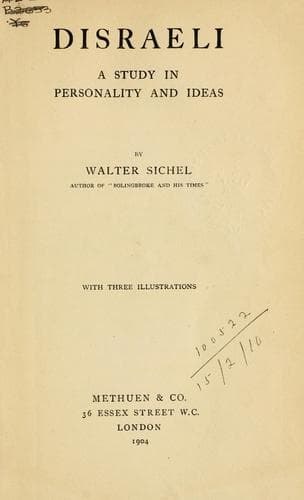
Disraeli: A Study in Personality and IdeasSichel, Walter
History
Disraeli: A Study in Personality and Ideas
Sichel, Walter
Disraeli, Benjamin, 1804-1881
This is true of Disraeli. Long before he entered public life, before
he knew the inimitable D’Orsay, or even the luminous Lyndhurst, before
his most happy marriage, he had entered society at both doors--the gate
of horn and the gate of ivory. As a stripling of twenty he had been
sent, as we have seen, by Murray, the founder of his own fortune on
Byron’s fortune and misfortunes, to Abbotsford and Sir Walter Scott.
The young Disraeli used to dub Murray “the Emperor.” Murray described
him as the most remarkable young man he had ever met; “a deep thinker
but thoroughly practical in his ideas,” at once brilliant and solid,
of a bright and airy disposition which endeared him to the young, and,
himself unspoilt as “a child;” singularly happy in his home relations,
and “his father is my oldest friend.” That father was himself a
singular and remarkable man, who had attracted a distinguished
coterie. He was Pye’s early intimate and Thomas Baring’s friend. His
ties with Penn cemented his love of Buckinghamshire. He was familiar
with Southey, and he knew Mrs. Siddons. He conversed with Samuel
Rogers[144] and Tom Moore; he had corresponded and dined with Byron,
of whom “Disraeli the Younger” has recorded some striking traits. He
knew all the men of quills and letters, including the antiquarian
Bliss and Douce, many of the wits, and some of the “wit-woulds.” His
own brother-in-law, George Basevi, was an eminent architect,[145] and
architecture is often touched in the son’s novels.[146] Another member
of the family was a conveyancer, and through him the son was first
sent to read law with a solicitor, in whose office he read Chaucer,
and was then entered at Lincoln’s Inn. He had artistic acquaintances
also. Barry, he knew well. Downman painted his wife, and Downman’s
brother was his associate. And there were also some men of affairs
who visited Isaac Disraeli’s house. The burrowing and irrepressible
Croker, afterwards so mercilessly satirised as “Rigby,”[147] and
equally trounced, poor man, by Thackeray and Macaulay, seems to have
been his occasional purveyor of politics. But for contemporary parties
he cared little. He was a solitary student of the past; excavating
ancient manuscripts in the British Museum when the daily number of
such scholars did not exceed six. He was shy, meditative, dreamy, and
dispassionate. But he was poet besides recluse; his earliest courtship,
while Dr. Johnson lay dying, had been that of the muse. Sir Walter
Scott included one of his lyrics in a published collection.[148]
He diversified his stern by lighter labours, and his novels, long
since moldered, caused some stir and attracted sympathy. After the
romance of his early failures and the surprise of his early success,
he set himself patiently down to work for ten years before he would
print another line. His own father, who never understood but always
humored him, was a man of business, sanguine and prompt, yet gay and
Public-domain text, read in full here on John Shaqi.
Reviews
Reviews
No reviews yet
Be the first to share your thoughts on this work.
Elsewhere in the archive
Join the Discussion
Join the discussion
Sign in to leave a comment or review.
Sign InorCreate an account