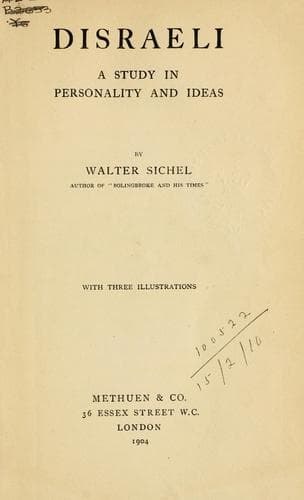
Disraeli: A Study in Personality and IdeasSichel, Walter
History
Disraeli: A Study in Personality and Ideas
Sichel, Walter
Disraeli, Benjamin, 1804-1881
nonchalant, who lost fortunes and regained them.[149] Disraeli the
Younger united the two strains of his father and of his grandfather. He
was a practical dreamer.
Isaac Disraeli, then, gave his boy an opening to the literary world.
Among his intimates was the shrewd solicitor, Mr. Austin, and his
clever young wife, a literary coquette of talent, the aunt of the
future Sir Henry Layard, the transcriber of _Vivian Grey_. Her salon
was frequented, among others, by the Hooks[150] and the Mathews.
With the Austins young Disraeli journeyed in Italy and Germany. From
his father’s library he thus emerged on a larger world. But he soon
outstepped its bounds. After his long Eastern travels with Clay, and
Meredith[151] affianced to Disraeli’s sister--a voyage on which Byron’s
Tita became Disraeli’s valet, and on which he encountered the most
opposite types as well as some curious adventures[152]--his own first
books made him the lion of several seasons. He and Bulwer divided the
honors of Bath, then still fashionable. Lyndhurst grew to depend on his
assistance, and even advice; Disraeli escorted him when as Chancellor
he was present at Kensington at the accession of Queen Victoria;
Lyndhurst’s daughter became an associate of Disraeli’s sister; and
nothing gave Disraeli more unfeigned pleasure than the visits of
Lyndhurst and Bulwer to his father at Bradenham.
He not only wrote novels, pamphlets, and sonnets (his vain ambition
was to revolutionise poetry), but he seems to have contributed to
the _Edinburgh Review_ as well as to many magazines. In 1833, as has
been noticed, he corresponded with its editor, Napier, with a view
to a “slasher” on Morier’s “Zohrab,” which had been puffed in the
_Quarterly_. Of the book he remarks, “A production in every respect
more contemptible I have seldom met with;” and of the puff, “This is
what comes of putting a tenth-rate novelist at the head of a great
critical journal.”[153]
Public-domain text, read in full here on John Shaqi.
Reviews
Reviews
No reviews yet
Be the first to share your thoughts on this work.
Elsewhere in the archive
Join the Discussion
Join the discussion
Sign in to leave a comment or review.
Sign InorCreate an account