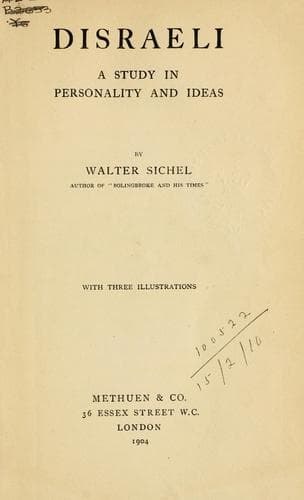
Disraeli: A Study in Personality and IdeasSichel, Walter
History
Disraeli: A Study in Personality and Ideas
Sichel, Walter
Disraeli, Benjamin, 1804-1881
We know from Lady John Manners,[21] and from other sources, how he
loved flowers, and forestry, and study during the dinner-hour, more
than all the social glitter; how he communed with the unseen; how
far-reaching were his sympathies; what interest and curiosity he
displayed in every form of career and purpose; how often to all the
splendour which he had conquered he preferred converse with the weak,
the lowly, the suffering; how his wise counsel and inexhaustible
resource were sought and coveted by cottagers, by the toilers whose
cause he made his own, by princes; how delicately considerate he was
in his appointments, and for all in contact with him, how he would
sacrifice a keen personal wish rather than disturb a pleasure or
abridge a holiday; and yet how his playfulness of fancy mixed in pithy
ironies with his very considerateness. A familiar instance--that of the
attached servant who was to enjoy “the pleasures of memory”--occurred
as he lay dying from the illness long and bravely concealed even from
his intimates. He was truly unselfish, and he was never known to blame
a subordinate. If things went wrong, he took the whole burden on his
own shoulders. He exerted infinite pains to understand the conditions
of and the organisations affecting labour.[22] The Buckinghamshire
peasants still cherish his memory; and it may be said with truth that
the deepest affections of this extraordinary man, whom vapid worldlings
sneered at as a callous cynic, were reserved for his country, his
county, his home, and his friends, for effort and for distress. Many
a young aspirant to fame, moreover, in literature or public life, has
owed much to his generous encouragement. He liked to dwell on the
vicissitudes of things,[23] and his own motto, “Forti nihil difficile,”
represents his conviction. In private, when he was not entertaining,
his habits were of the simplest. In two things only he was profuse;
books and light. He loved to see every room of Hughenden illuminated
with candles. He was utterly careless of money. It is related, that
when he accepted the Chancellorship of the Exchequer, he sent for the
celebrated Mr. Padwick, and asked for a necessary advance. “On what
security?” inquired the sporting speculator. “That of my name and my
career,” was the answer. And the money was at once forthcoming, and
punctually repaid. As is well known, he would often make his greatest
efforts half dinnerless; and his delight was, after the strain and
the plaudits had ceased, to betake himself in the dim hours of dawn
to the supper which his devoted wife, who spared him every detail of
management, had prepared, and there to recount to her the excitements
of the debate. The pair would certainly have endorsed those verses of
Lady Mary Wortley Montagu, of which Byron was so fond--
Public-domain text, read in full here on John Shaqi.
Reviews
Reviews
No reviews yet
Be the first to share your thoughts on this work.
Join the Discussion
Join the discussion
Sign in to leave a comment or review.
Sign InorCreate an account