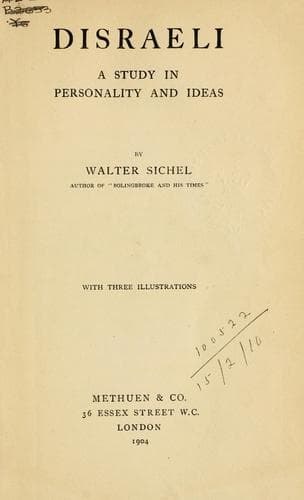
Disraeli: A Study in Personality and IdeasSichel, Walter
History
Disraeli: A Study in Personality and Ideas
Sichel, Walter
Disraeli, Benjamin, 1804-1881
What he admired in whatever form--even when incompatible with
society--was purpose with personality. This is manifest in all his
early novels, conspicuous in his later ones. The two heroes of
_Venetia_--Byron and Shelley[157]--are portrayed from this point
of view. Even the hysterical purpose of Lady Caroline Lamb in the
person of “Lady Monteagle” is recognised; and of Byron he causes his
characters to speak in _Vivian Grey_: “There was the man! And that
such a man should be lost to us at the very moment that he had begun
to discover why it had pleased the Omnipotent to have endowed him
with such powers!”--“If one thing were more characteristic of Byron’s
mind than another, it was his strong, shrewd common sense, his pure,
unadulterated sagacity.”--“The loss of Byron can never be retrieved.
He was indeed a real man; and, when I say this, I award him the most
splendid character which human nature need aspire to.”[158] The very
intellectual purpose of comparative purposelessness, of dilettante
taste, attracted him. This is how he addresses “Luttrell” in _The Young
Duke_: “... Teach us that wealth is not elegance, that profusion is
not magnificence, and that splendour is not heart. Teach us that taste
is a talisman which can do greater wonders than the millions of the
loan-monger. Teach us that to vie is not to rival; and to imitate not
to invent. Teach us that pretension is a bore. Teach us that wit is
excessively good-natured, and, like champagne, not only sparkles, but
is sweet.[159] Teach us the vulgarity of malignity. Teach us that envy
spoils our complexions, and that anxiety destroys our figure. Catch the
fleeting colours of that sly chameleon, Cant, and show what excessive
trouble we are ever taking to make ourselves miserable and silly. Teach
us all this, and Aglaia shall stop a crow in its course, and present
you with a pen, Thalia hold the golden fluid in a Sévres vase, and
Euphrosyne support the violet-coloured scroll.”
So, too, the energetic personality of D’Orsay aroused his enthusiastic
friendship, and drew from him, some twenty years after that ambrosial
figure had vanished, the tribute of “... the most accomplished and the
most engaging character that has figured in this century, who, with
the form and universal genius of an Alcibiades, combined a brilliant
wit and a heart of quick affection, and who, placed in a public
position, would have displayed a courage, a judgment, and a commanding
intelligence which would have ranked him among the leaders of mankind.”
D’Orsay speaks and acts to the life as “Count Mirabel” in _The Young
Duke_. And, in a too unfamiliar passage of _The Young Duke_, he thus
also embalms, I fancy,[160] the memory of Lady Blessington’s maligned
charm under the veil of “Lady Aphrodite.”
Public-domain text, read in full here on John Shaqi.
Reviews
Reviews
No reviews yet
Be the first to share your thoughts on this work.
Elsewhere in the archive
Join the Discussion
Join the discussion
Sign in to leave a comment or review.
Sign InorCreate an account