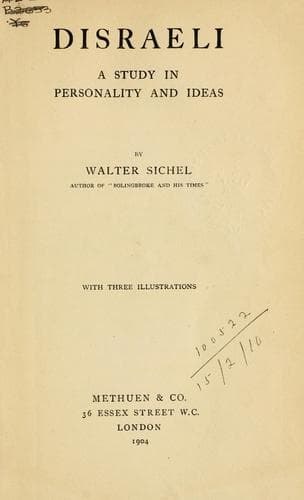
Disraeli: A Study in Personality and IdeasSichel, Walter
History
Disraeli: A Study in Personality and Ideas
Sichel, Walter
Disraeli, Benjamin, 1804-1881
love the thought of another woman is uninteresting, if not repulsive.
Constancy is human nature. Instead of love being the occasion of all
the misery of this world, as is sung by fantastic bards, _I believe
that the misery of this world is occasioned by there not being love
enough_.... Happiness is only to be found in a recurrence to the
principles of human nature, and these will prompt very simple manners.
For myself, I believe that permanent unions of the sexes should be
early encouraged; nor do I conceive that general happiness can ever
flourish but in societies where it is the custom for all males to
marry at eighteen. This custom, I am informed, is not unusual in the
United States of America, and its consequence is a simplicity of
manners and purity of conduct _which Europeans cannot comprehend, but
to which they must ultimately have recourse_. Primeval barbarism and
extreme civilisation must arrive at the same results. Men under these
circumstances are actuated by their structure; in the first instance
instinctively, in the second philosophically. At present[168] we are
all in the various gradations of the intermediate state of corruption.”
At all events, his own compositions were conspicuously spotless; and
it may be said of him, as it was of Addison--so unlike otherwise--“No
whiter page remains.”
Such, then, are some of Disraeli’s main ideas on the outward forms and
inward spirit of society. Fashionable “society” he played with, and
he used--it amused him; but he never cherished, rather he scorned it.
Power he valued; and fame--“the opinion of mankind after death”--for
him meant power. There was once a certain rather fussy Radical member
who had long been anxious to make his acquaintance. When _Lothair_
appeared, he rushed up to Disraeli excitedly, with many apologies
for the intrusion, and begged him to receive the assurance of his
daughter’s intense admiration for that work. “Thank you ever so much,”
returned Disraeli, “_and this is fame_!”
Public-domain text, read in full here on John Shaqi.
Reviews
Reviews
No reviews yet
Be the first to share your thoughts on this work.
Elsewhere in the archive
Join the Discussion
Join the discussion
Sign in to leave a comment or review.
Sign InorCreate an account