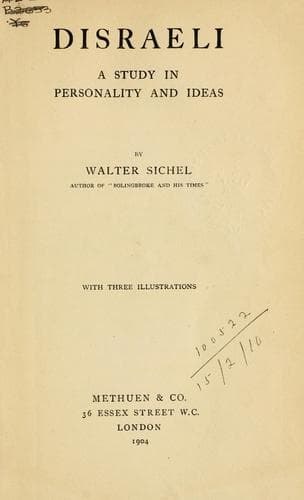
Disraeli: A Study in Personality and IdeasSichel, Walter
History
Disraeli: A Study in Personality and Ideas
Sichel, Walter
Disraeli, Benjamin, 1804-1881
When the gorgeous trinket was in his grasp, and he was at the zenith
of his eminence, I have already recorded an impressive instance. I may
contrast with this another picture, also of a fact already chronicled
in the interesting recollections of a young associate of his old age.
It will bear repetition. The scene was Hughenden in late autumn, the
time, after Lady Beaconsfield’s death. He sat in reverie before the
fire, watching the flickering embers. “Dreams, dreams, dreams,” he
murmured, as the wreaths of smoke and the sparks of flame went upwards.
He was thinking of his favourite Sheridans, by whose own fireside, and
basking in whose sunshine of wit and beauty, so many of his happiest
evenings had been spent forty years agone. And perhaps, also, he was
thinking of that charming daughter of Lord Lyndhurst, whose pet name
tallied with his own sister’s; and possibly, too, of that little
Frances Braham, whom he had known in girlhood, and whom, after she,
too, had carved a career, he still knew and admired as Frances, Lady
Waldegrave.
Yet one more dissolving view--
The scene shifts again to London and a Foreign Office reception, with
its gaping throng. It was the last function that Lady Beaconsfield,
frail with age and bent with rheumatism, was able to attend. Step by
step, all the way down that long staircase, he himself planted her
feet and tenderly supported her feeble frame, till, when she reached
the end, he presented to her a youth of promise, since a member of
ministries, who will still remember it.
Yes, it was companionship, not “society,” that was precious to him. And
trial proves friendship.
“‘Since I last met you, I heard you had seen much and suffered
much.’--‘And that makes the kind thoughts of friends more
precious.’--‘You have, however, a great many things which ought to make
you happy.’--‘I do not deserve to be happy, for I have made so many
mistakes....’--‘Take a brighter and a nobler view of your life.... Feel
rather that you have been tried and not found wanting.’”
[Illustration: DISRAELI IN 1852
_After a painting by Sir Francis Grant, P.R.A._]
CHAPTER IX
LITERATURE
WIT, HUMOUR, ROMANCE
Whatever Disraeli wrote was always literature, and never lecture. He
was a born man of letters, and Dickens once lamented that politics had
so long and often deprived fiction of a master.
Disraeli is renowned for his wit; but he is not so generally famed for
two qualities in which he excelled, though with limitations--his subtle
sense of humour and his fine feeling for the picturesque and romantic.
Public-domain text, read in full here on John Shaqi.
Reviews
Reviews
No reviews yet
Be the first to share your thoughts on this work.
Elsewhere in the archive
Join the Discussion
Join the discussion
Sign in to leave a comment or review.
Sign InorCreate an account