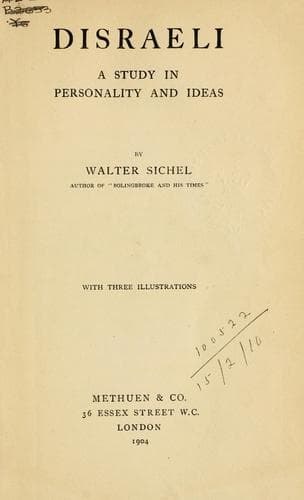
Disraeli: A Study in Personality and IdeasSichel, Walter
History
Disraeli: A Study in Personality and Ideas
Sichel, Walter
Disraeli, Benjamin, 1804-1881
Like his own “Sidonia,” Disraeli “said many things that were strange,
yet they instantly appeared to be true;” like his own “Pinto,” he “had
the art of viewing common things in a fanciful light.” I shall notice
both these characteristics. He believed in the force of phrases as a
pollen, so to speak, of ideas wafted through the air; and he believed
in the perpetual miracles of existence. His favourite English authors
were the romantics of Queen Elizabeth and the wits of Queen Anne and
the Georges.
It was once said that wit is a point, but humour a straight line.
This epigram is inadequate. Wit is no _résumé_ of humour; the two
qualities differ in kind. Wit is a department of style; and style
is gesture, accent, expression. Wit is the faculty of combining the
unlike, by the language of illustration, suggestion, and surprise.
It sums up characters, things, and ideas. Like misery, “it yokes
strange bedfellows,” but with the link of words alone. It is best when
intellectually true, but its requisite is _fancy_, and its domain
expression. Humour, on the other hand, is an exercise of perceptive
sympathy; it is the faculty of discerning the incongruous, especially
of human nature, in the visible alone; it “looks on this picture and
on that;” it is most excellent when ethically sound, but its essence is
insight, and its sphere, situation.
No one ever heard of a witty picture, or a humorous epigram. We laugh
at humour, whereas at wit we smile. Wit is, as it were, Yorick with cap
and bells; but humour unmasks him with a moral. Popular proverbs are
the wit of the people; what the crowd laughs at is its humour, and its
humour varies in different countries; but the standard of wit is the
same in all civilisations. To define wit and humour would require both
qualities, but, if I were to try my hand, I would venture to call wit,
mirth turned philosopher--humour, philosophy at play.
Public-domain text, read in full here on John Shaqi.
Reviews
Reviews
No reviews yet
Be the first to share your thoughts on this work.
Elsewhere in the archive
Join the Discussion
Join the discussion
Sign in to leave a comment or review.
Sign InorCreate an account