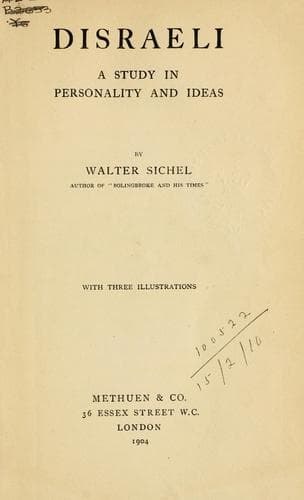
Disraeli: A Study in Personality and IdeasSichel, Walter
History
Disraeli: A Study in Personality and Ideas
Sichel, Walter
Disraeli, Benjamin, 1804-1881
When Disraeli was out of office for the last term, he was walking with
a leading member of the Government that had replaced his own. The
statesman asked him how he thought the new Administration was getting
on. “Pretty well,” was his answer, “but I like the old-fashioned
methods. The first year you do nothing; the second year you talk
of doing something; the third year you do something--and succeed;
the fourth you do something--and fail; the fifth year you spend in
discussing whether it was a failure or not; the sixth, you go to the
country, _who pronounce that it was_.”
Most of these are to some degree fanciful _persiflage_. Not so the
following--a passage alluded to in a note already, and compared
with another one from Heine. He is describing the Vintage Feast of
Tabernacles, and the passage is the more remarkable because Disraeli’s
father instances this very festival as one of the obsolete and
fanatical absurdities that unfit the Old Testament religion for its
proper fulfilment by the New:--
“Picture to yourself the child of Israel in the dingy suburb or the
stolid quarter of some bleak Northern town, where there is never a sun
that can at any rate ripen grapes; yet he must celebrate the vintage
of purple Palestine.... He rises in the morning, goes early to some
Whitechapel market, purchases some willow boughs for which he has
previously given a commission, and which are brought probably from one
of the neighbouring rivers of Essex, hastens home, cleans out the yard
of his miserable tenement, builds his bower, decks it even profusely
with the finest flowers and fruit he can procure, and hangs its roof
with variegated lamps. After the service of his synagogue, he sups late
with his wife and children, as if he were in the pleasant villages of
Galilee beneath its sweet and starry sky.... Perhaps as he is offering
up the peculiar thanksgiving, ... and his wife and children are joining
in a pious ‘Hosanna’--that is, ‘Save us’--_a party of Anglo-Saxons,
very respectable men, ten-pounders, a little elevated, it may be,
though certainly not in honour of the vintage, pass the house, and
words like these are heard: ‘I say, Buggins, what’s that row?’ ‘Oh,
it’s those cursed Jews! We’ve a lot of them. It’s one of their horrible
feasts. The Lord Mayor ought to interfere. However, things are not so
bad as they used to be. They used always to crucify little boys at
their hullabaloos, but now they only eat sausages made of stinking
pork.’ ‘To be sure,’ replies his companion, ‘we all make progress.’_”
And there are many pendants to this kind of pathetic humour in the sad
vagaries, degraded ignorance, sordid joys and squalid sorrows of the
operatives of “Wodgate” so sympathetically presented in _Sybil_:--
Public-domain text, read in full here on John Shaqi.
Reviews
Reviews
No reviews yet
Be the first to share your thoughts on this work.
Elsewhere in the archive
Join the Discussion
Join the discussion
Sign in to leave a comment or review.
Sign InorCreate an account