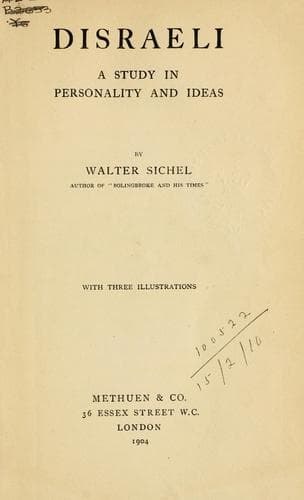
Disraeli: A Study in Personality and IdeasSichel, Walter
History
Disraeli: A Study in Personality and Ideas
Sichel, Walter
Disraeli, Benjamin, 1804-1881
“... ‘They call me Tummas, but I ayn’t got no second name; but now I’m
married I mean to take my wife’s, for she has been baptised, and so
has got two.’ ‘Yes, sir,’ said the girl with the vacant face and the
back like a grasshopper, ‘I be a reg’lar born Christian, and my mother
afore me, and that’s what few gals in the yard can say. Thomas will
take to it himself when work is slack; and he believes now in Our Lord
and Saviour Pontius Pilate, who was crucified to save our sins, and
in Moses, Goliath, and the rest of the apostles.’ ‘Ah, me!’ thought
Morley, ‘and could not they spare one missionary from Tahiti for their
fellow-countrymen at Wodgate?’”
* * * * *
I must turn to the romantic and the picturesque in Disraeli’s fiction.
It is a large subject, but it need not necessitate a long treatment.
The Brontës and Bulwer Lytton, in opposed spheres and with opposite
material, are perhaps the only modern pure romantics in English
fiction, before the romantic revival of the last twenty years or
so had set in. In the early nineteenth century Sir Walter Scott had
headed another romantic revival. Miss Austen, however,--the miniaturist
of realism--recalled fiction in her delicate manner to the beaten
high-road of the eighteenth. Dickens, romantic by instinct, dwelt on
the horrible and grotesque, and was more melodramatic than strictly
romantic. Thackeray, sternly combating the infinite romance of his
own nature, disclaimed a hero, and proved sentimental rather than
romantic. Trollope, who photographed feeling, abominated romance.
George Eliot set out as a romantic, but she soon became gloriously
whelmed in the vortex of scientific psychology. Others, who lack her
imagination, have since followed in her track. We have been treated to
analytic presentations of life, where some five persons engage in a
mutual war of motive, and the very reasons for turning a door-handle
are minutely involved in character. On the one hand, we had the
English and French sensationalists elaborately unravelling mysteries;
on the other, the boudoir psychologists as elaborately anatomising
moods. The great “naturalist” school supervened with its claims to
scientise misery. Victor Hugo’s romanticism was doomed by the merciless
lancet of these literary surgeons. And throughout--even now, in the
main, using “romance” more with regard to situation and expression
than to events--the purely and simply heroic and adventurous has
lost ground. Mind rather than action engrossed a great part of late
nineteenth-century fiction.
Public-domain text, read in full here on John Shaqi.
Reviews
Reviews
No reviews yet
Be the first to share your thoughts on this work.
Elsewhere in the archive
Join the Discussion
Join the discussion
Sign in to leave a comment or review.
Sign InorCreate an account