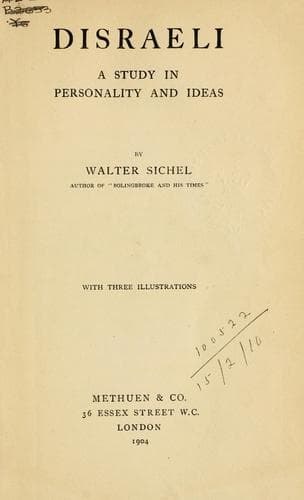
Disraeli: A Study in Personality and IdeasSichel, Walter
History
Disraeli: A Study in Personality and Ideas
Sichel, Walter
Disraeli, Benjamin, 1804-1881
Disraeli’s marriage was the happiest turning-point in his career;
and that which had begun partly in interest, soon developed into the
warmest, the most entire and the most mutual affection. Mrs. Disraeli,
at a great country house, always used to commence conversation by
the query, “Do you like my Dizzy? Because, if you don’t----” From
another, on a visit most advantageous to him, Disraeli departed,
despite pressing remonstrance, on the plea that the “air” disagreed
with Mrs. Disraeli--because she had complained of their host’s
rudeness. It will one day be found that to this gifted and selfless
woman, English history owed much at several serious conjunctures. I
cannot resist relating a good story in another vein. Shortly after
Disraeli’s marriage, a guest at Grosvenor Gate, pointing to a portrait
of the late Mr. Wyndham Lewis, Mrs. Disraeli’s first husband and with
Disraeli member for Maidstone, asked him whom it represented. “Our
former colleague,” was the rejoinder. At a much later date Mr. Frith
was painting a group in which Disraeli figured. As her husband was
going, Mrs. Disraeli whispered to the artist, “Remember one thing, if
you don’t mind, his pallor is his beauty.” She was afraid that his
complexion would be coloured. To the last she would say, as she did
during his interrupted speech at Aylesbury in 1847:--“_He_ mind them!
Not a bit of it. He’s a match for them all.” Sir Horace Rumbold has
just told us how, at the scene of Disraeli’s investiture as Earl, a
sob was heard from the crowd. It was the grief of an old and faithful
servant sighing, “Ah! If only _she_ had lived to see him now!”
Like childless men in general, he was devoted to children. More than
one still living remembers his happy words of playful intimacy. To
women from the days of his pet Sheridans to those of the present Lady
Currie, he appealed with magnetism throughout his career, and there are
few more romantic episodes than his meetings, after hesitation, with
the elderly Mrs. Bridges Williams at the fountain in the Exhibition of
1862, the existing correspondence which ensued, and the thumping legacy
which crowned it. One who has read that correspondence has assured me
that its gentle chivalry is most striking. In the midst of engrossing
occupation he never ceased to cheer the old lady with gossip of his
doings, and even to argue with her, as on an affair of state, regarding
the advisability of Struve’s seltzer water as a remedy.
Of Queen Victoria’s affection for him I will only say that it was
because he treated her as a woman. She grew to lean on his wisdom and
his judgment. On more than one occasion he acted as mediator in her
family. He was sincerely attached to her. His witticism, when asked for
a reason of her favour, will bear repetition: “I never argue, I never
contradict, but I sometimes forget.”
Public-domain text, read in full here on John Shaqi.
Reviews
Reviews
No reviews yet
Be the first to share your thoughts on this work.
Join the Discussion
Join the discussion
Sign in to leave a comment or review.
Sign InorCreate an account