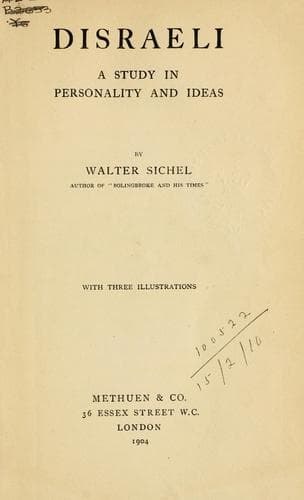
Disraeli: A Study in Personality and IdeasSichel, Walter
History
Disraeli: A Study in Personality and Ideas
Sichel, Walter
Disraeli, Benjamin, 1804-1881
With all faults, native and imposed, Disraeli proclaimed in his novels,
in those which were political fairy-tales, as in those which were not,
“adventures are to the adventurous;” and this very phrase, too, occurs
in his earliest satire. _Contarini Fleming_ was originally styled “The
Psychological Romance;” _Alroy_ is undoubtedly a romance historical;
_The Young Duke_, a romance of fashion; _Vivian Grey_, one both of
fashion and of ambition; _Venetia_, of biography; _Henrietta Temple_,
of love; and the rest, romances of the world’s actors and action.
But the extraordinary is merely the mantle of romanticism proper.
Its method is everything. It is one that brings up before us at
once the thing seen and the man seeing. It releases individuality
from stereotyped shackles, it transfers interest from achievement to
achievement’s atmosphere, and it lends to landscape-painting the same
element that it lends to character-drawing.
The French separate their terms in distinguishing between real
and feigned romance. The one they call _romantique_; the other,
_romanesque_. The really romantic in fiction is so to write as to
import into the interest of the extraordinary the interest also
of the author’s temperament. Both the unusual subject and the
imparted atmosphere are requisites. _Rasselas_ is an unusual subject
sententiously treated. It is parable, not romance. The _Song of the
Shirt_ is an, alas! commonplace theme transfigured by sympathy. It
is pathetic, not romantic. Sir Walter Scott, however, is romantic
_par excellence_. We are sure that his background is unusual, and he
stamps his individuality on the foreground. So, too, with his pictures
of scenery. The writer’s heart, rather than his head, pervades the
perspective. The unromantic author is a showman, the romantic author
an actor. The one fits character to persons; the other from persons
evolves character. The romantic reveals the wonderful to us by
personal feeling. Ruskin once defined the picturesque as “parasitical
sublimity;” Carlyle, too (as romantic and picturesque himself as
Ruskin), denounces the faculty in which he excelled. But these
thinkers failed, perhaps, to grasp that the root of the most beautiful
impressions is association interwoven with memory, fancy, affection,
even superstition, and the symbols of very names. Strip Venice of her
climate, rob man of his memory, and where is the Venice that Ruskin
adored? Absolute beauty does exist, but rarely; and we atone for
imperfections by supplementing it with the endearments of outward
accident. It is Nature’s own method; she garlands the rift of ruins
with her greenery. The dead letter sleeps in literature as in life, of
which literature ought to be the most sensitive mirror. Warmth is as
indispensable as light; and if fiction is to remain an art and not sink
into a false science, the dry bones of hard facts must be made to live.
By these means, too, the personal influence of great writers is most
practically preserved.
Public-domain text, read in full here on John Shaqi.
Reviews
Reviews
No reviews yet
Be the first to share your thoughts on this work.
Elsewhere in the archive
Join the Discussion
Join the discussion
Sign in to leave a comment or review.
Sign InorCreate an account