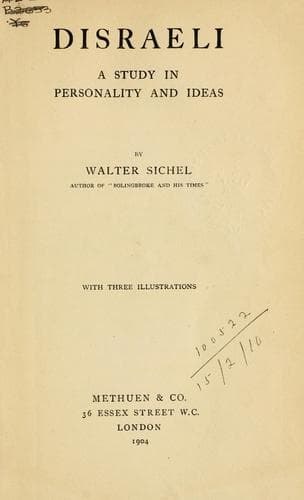
Disraeli: A Study in Personality and IdeasSichel, Walter
History
Disraeli: A Study in Personality and Ideas
Sichel, Walter
Disraeli, Benjamin, 1804-1881
London’s motley vastness, too, and magnetism of attraction were
constantly his themes. “... It is a wonderful place, ... this London; a
nation, not a city; with a population greater than some kingdoms, and
districts as different as if they were under different governments, and
spoke different languages.” And yet (of “Lothair”), “I have been living
here six months, and my life has been passed in a park, two or three
squares, and half a dozen streets!”
In _Vivian Grey_ Disraeli whimsically observed that literature was
declining in the ’twenties through a wealth grown so luxurious as to
rank it with “ottomans, bonbons, and pier-glasses.” “Consols at a
hundred were the origin of all book societies. There is nothing like a
fall in consols to bring the blood of our good people of England into
good order.”
Consols have now fallen, and maybe literature is reviving. Certain I
am that, when its revival becomes pronounced, it will be through the
invigoration of romance. The strange need not be sought in the remote.
Wordsworth found it in “laughing daffodils,” as truly as Byron in the
Corsair. Unromantic matter, romantically treated, is more refreshing
than romantic matter unquickened by personal feeling--by
“_Quod latet arcanâ non enarrabile fibrâ_.”
I have mentioned Disraeli’s early tendency towards “Ha!” and “Pah!” For
this there were several reasons besides his own temper and that of the
time.
When we speak of an “artificial” style we mean one unnatural to the
author. Disraeli’s style was perfectly natural to him, and it altered
little. To impose another man’s voice on our own is real artifice. How
natively pathetic he could be, is shown by the scene in _Vivian Grey_,
where the broken Cleveland sits and sobs amid the laughing children on
his lonely bench in Kensington Gardens; and how simply pleasing, by the
encounter after long years between “Coningsby” and “Lady Theresa.” He
constantly alternates between the homely and the outlandish.
Public-domain text, read in full here on John Shaqi.
Reviews
Reviews
No reviews yet
Be the first to share your thoughts on this work.
Elsewhere in the archive
Join the Discussion
Join the discussion
Sign in to leave a comment or review.
Sign InorCreate an account