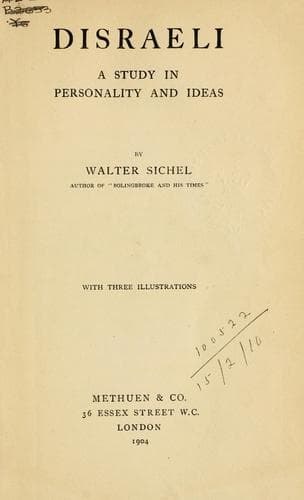
Disraeli: A Study in Personality and IdeasSichel, Walter
History
Disraeli: A Study in Personality and Ideas
Sichel, Walter
Disraeli, Benjamin, 1804-1881
In the few years preceding his grand tour, and, still more, the earlier
_Vivian Grey_, he was at a phase in his development when he was only
just beginning to realise the true bent of his powers, of which he had
from the first been conscious, but which had hitherto more or less
perplexed and bewildered him. In _Alroy_ and _Contarini_ his tone
is one of savage force as yet unchastened and unmellowed. The wild
Arab is in them. All the over-mastering dreams of his youth claimed
materialisation; his language went before his feelings, and strove to
outrun them by vehement strokes of attitude. He thirsted for action,
and yet drooped, restless and mortified. His circumstances were at war
with his consuming ambitions. It was the discord of a peculiar fate and
an unique organisation; the ferment of a ripe spirit cooped by unripe
experience, of an as yet untempered vigour. The genius, as in the old
legend, shrank and dwindled in the bottle, but soared with gigantic
stature when the stopper was released. One must not take the personal
touches in _Vivian_, _Alroy_, and _Contarini_ too literally. They are a
blend of several factors and of various characters; and he himself in
his age regretted that the last had been the task of immaturity. But
from the main emphasis and the prevailing moods of the three together,
thus much one may gather.
“Why, what is life” (this from _Alroy_), “for meditation mingles ever
with my passion?... Throw accidents to the dogs, and tear off the
painted mask of false society! Here am I, a hero; with a mind that can
devise all things, and a heart of superhuman daring, with youth, with
vigour, with a glorious lineage ... and I am--nothing.” He was morbidly
overdone, and he brooded and overdid his own morbidity. He had lived
in “a private world and a public world,” and the two were still at
variance. “I was,” he says extravagantly of a still earlier date, on
the lips of “Contarini,” “in these days but a wild beast who thought
himself a civilised human being;” and yet “I felt the conviction that
literary creation was necessary to my existence.”--“What vanity in all
the empty bustle of common life! It brings to me no gratification;
on the contrary, degrading annoyance. It develops all the lowering
attributes of my nature.” He was impatient, and yet he felt that
“patience is a necessary ingredient of genius.” “Nothing is more
fatal than to be seduced into composition by the first flutter of
the imagination.” He had aspired to be a poet, and a poet in a new
style befitting modern life. The failure of the _Revolutionary Epick_
disgusted him; yet how could he have expected it to succeed? even if it
had been sold at a farthing, as in the case of Mr. Horne’s experiment,
it would never have attracted the public, for it was a long essay
in stilted verse.[176] He still aspired to influence and rule his
fellow-men, but no path was clear. These moods were not to last. “Think
of me as of some exotic bird which for a moment lost its way in thy
Public-domain text, read in full here on John Shaqi.
Reviews
Reviews
No reviews yet
Be the first to share your thoughts on this work.
Elsewhere in the archive
Join the Discussion
Join the discussion
Sign in to leave a comment or review.
Sign InorCreate an account