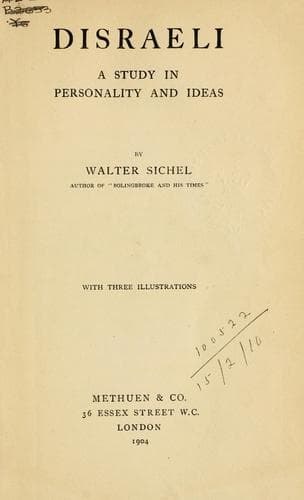
Disraeli: A Study in Personality and IdeasSichel, Walter
History
Disraeli: A Study in Personality and Ideas
Sichel, Walter
Disraeli, Benjamin, 1804-1881
These are not the blemishes of his great political novels; but there
is in them also, with all their deep thought and striking insight,
their absolute originality and stimulating suggestiveness, an air at
times of the perfumer’s shop rather than of the fresh air. Even “Sybil”
cries out, “Oh! the saints, ’tis a merry morn!” “Coningsby” meets his
lady-love at a ball, which “is a dispensation of almost supernatural
ecstasy;” and in _Lothair_ itself we revert to “barbs” and “jennets.”
I think that these later defects were partly due to the reaction
against the constraint, repression, and formality compelled by his
political career. They were a reaction in form, but in no case were
they artificial in substance. They meant something, and they pressed
it home. Disraeli was always a fantastic, and the fantastic holds
high rank in literature. It distinguishes Disraeli’s pet, Cervantes.
But fantasy is different far from frippery. Fantasy is the flicker of
firelight, not the flare of gas.
Again, it is always hard for originality to win a first hearing from
the public. Browning once remarked in a letter that to fasten the
attention of the British public some stroke of style is required. This
is true. Browning is himself an example; Carlyle, another; for his
early essays completely lack that compound of Jean Paul’s German, and
old Mrs. Carlyle’s Scotch, out of which Carlylese was evolved. Ruskin
is another instance. Disraeli in his correspondence is far more free
and flowing than in his books. Of those books there is least trace of
apparent affectation in _Coningsby_, which is the best political novel
in any language. Reviewed as a whole, his novels are creative, and a
marvellous medium for thought. Some bedizenment there is doubtless, and
there are many gauds of fancy; and parts of the characterisation may be
said to be written in italics. It is true also that some of the persons
are waxworks, but none of the characters are, and his movement of
ideas, as well as his ideas of movement, display a flexibility rarely
joined to such piercing penetration. Next to his three great political
novels and in some respects above them, I would rank _Venetia_,
which has never met with such widespread appreciation. _Alroy_ and
_Contarini_ are psychological romances, exceptional of their kind. His
method of composition was the same throughout his life. He pondered in
the night what he penned in the morning. And of his early preparation
he has left a memorial--
Public-domain text, read in full here on John Shaqi.
Reviews
Reviews
No reviews yet
Be the first to share your thoughts on this work.
Elsewhere in the archive
Join the Discussion
Join the discussion
Sign in to leave a comment or review.
Sign InorCreate an account