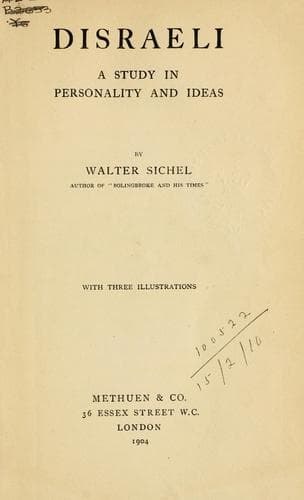
Disraeli: A Study in Personality and IdeasSichel, Walter
History
Disraeli: A Study in Personality and Ideas
Sichel, Walter
Disraeli, Benjamin, 1804-1881
“... I prepared myself for composition in a very different mood
from that in which I had poured forth my fervid crudities in the
Garden-house. Calm and collected, I constructed characters on
philosophical principles, and mused over a chain of action which should
develop the system of our existence. All was art. I studied contrasts
and grouping, and metaphysical analysis was substituted for anatomical
delineation. I was not satisfied that the conduct of my creatures
should be influenced merely by the general principles of their being; I
resolved that they should be the very impersonations of the moods and
passions of our mind. _One was ill-regulated will;[179] another offered
the formation of a moral being_;[180] materialism sparkled in the
wild gaiety and reckless caprice of one voluptuous girl, while spirit
was vindicated in the deep devotion of a constant and enthusiastic
heroine.[181] Even the lighter temperaments were not forgotten.
Frivolity smiled and shrugged her shoulders before us, and there was
even a deep personification of cynic humour.”
He believed in the influence of the creative arts on creative
authorship. He has pointed out how the Tuscan school of painting trains
to the grandeur of simplicity, the Venetian to the gorgeousness of
fancy. And of music he has written: “The greatest advantage that a
writer can derive from it is that it teaches most exquisitely the art
of development. It is in remarking the varying recurrence of a great
composer to the same theme, that a poet may learn how to dwell upon
the phases of a passion,--how to exhibit a mood of mind under all its
alterations, and gradually to pour forth the full tide of feeling.”
But he thought that such influences were a prelude to creation, not to
execution. “It is well to meditate upon a subject under the influence
of music, but to execute we should be alone, and supported only by our
essential and internal strength.”
As is familiar, he was fastidious even when he was florid. It is well
known that he relieved his last illness by correcting the proofs of his
last speeches for Hansard--“the Dunciad of Politics.” “I will not,” he
said, “descend to history speaking bad grammar.”
About national literature he held views which sprang from his theories
of race. He considered that modern Europe depended overmuch on ideas
derived from Rome, Greece, and Palestine. “At the revival of letters
we beheld the portentous spectacle of national poets communicating
their inventions in an exotic form.... They sought variety in increased
artifice of diction, and substituted the barbaric clash of rhyme for
the melody of the lyre....” Spain, he thought, offered the best field
for a national novel.
“The outdoor life of the natives induces a variety of the most
picturesque manners, while their semi-civilisation makes each district
retain with barbarous jealousy its peculiar customs.”
Public-domain text, read in full here on John Shaqi.
Reviews
Reviews
No reviews yet
Be the first to share your thoughts on this work.
Elsewhere in the archive
Join the Discussion
Join the discussion
Sign in to leave a comment or review.
Sign InorCreate an account