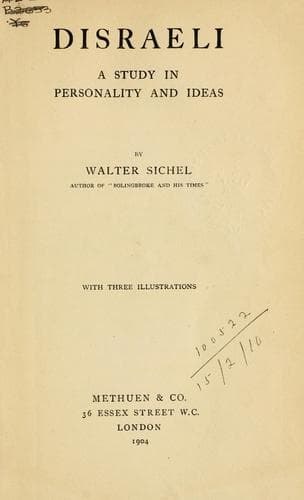
Disraeli: A Study in Personality and IdeasSichel, Walter
History
Disraeli: A Study in Personality and Ideas
Sichel, Walter
Disraeli, Benjamin, 1804-1881
Such, then, were for him the equipments of career. Of its arts in
attaining what it designs to exercise for the good of others, much will
have been gleaned from many citations as to tact and temper. There is
one other maxim of worldly wisdom which is worth recording: “If you
wish a man to be your friend, allow him to confute you.” His idea of
power was that it was “a divine trust,” but it was also a cumulative
fund. “The very exercise of power only teaches me that it may be
wielded for a greater purpose.” Mrs. Disraeli said, when her husband
had, in his own words, “climbed to the top of the greasy pole at last,”
“You don’t know my Dizzy, what great plans he has long matured for the
good and greatness of England. But they have made him wait and drudge
so long--and now time is against him.”
It is not here my province to track the details of his own career. This
book deals with his ideas. But with the interesting psychology of his
early temperament I mean to deal, for it concerns his ideas.
I might, had his career been within my scope, have cleared some
doubts, and explained many misunderstandings. I could have shown, as
I have shown elsewhere, the real truth about the Peel letter, and the
events of 1851-52. I should have pointed out the dividing lines in
his campaign and the halting-places in his march, the Eastern tour,
his marriage, his estrangement from Peel, the Crimean War, his steady
progress in social improvements, his Reform Bills of 1859 and 1867,
the strong effect on his outlook of events of magnitude, and the last
act of the drama--his imperialism. I might also have explained the
moot points connected with the years 1833, 1835, 1837, 1846, 1851,
and 1860.[184] I might, perhaps, have been able to shed light on the
delayed Malmesbury despatches in 1859. Nor should I have shirked his
mistakes, notably the motion of censure on Lord Palmerston. And I would
have dwelt on the striking influences which his sister and his wife
exercised over him.
But one brief topic I shall skim before I finally trace something of
his own peculiar development.
Public-domain text, read in full here on John Shaqi.
Reviews
Reviews
No reviews yet
Be the first to share your thoughts on this work.
Elsewhere in the archive
Join the Discussion
Join the discussion
Sign in to leave a comment or review.
Sign InorCreate an account