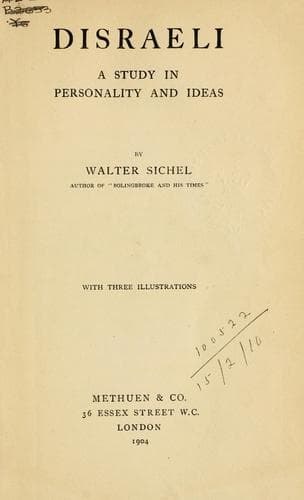
Disraeli: A Study in Personality and IdeasSichel, Walter
History
Disraeli: A Study in Personality and Ideas
Sichel, Walter
Disraeli, Benjamin, 1804-1881
Much has been talked of his alien “aloofness.” As for alien, Mazarin
was in this sense an “alien,” not to speak of the less worthy examples,
Alberoni and Ripperda. In the eighteenth century a Scotch premier
was in England an “alien.” Augustus was partly, Napoleon wholly, an
“alien.” And what but “aliens” were Manin, Gambetta, Lasker, Midhat,
and Emin? Nobody understood his countrymen more shrewdly at once and
sympathetically than Disraeli. His was no sham patriotism, and he loved
John Bull fondly, even when he poked fun at him. Nor had any pondered
more deeply the lessons which history imparts. There are, however,
two grains of truth in this reproach. He did regard the world and its
history as a fleeting show. He believed in recurring cycles. What is
now old was once new; what is new will one day be old. So long as
individuals worked their best, what did it matter? One civilisation
succeeds another, and the last state of a mighty nation is often worse
than the first. “The whirligig of Time brings about his revenges.” In
this sense--the historical and philosophical sense--he might be called
indifferentist. And again, he understood England, but it took long for
his countrymen to understand _him_. When they came to do so, he met
with that generosity which immense bravery and perseverance always
eventually receive; but, meanwhile, he had struggled against a jealous
malice which is, perhaps, peculiar to politics. He had “educated”
his followers, but suspicion and misunderstanding hampered his every
step. During two spans of some six years each (without counting his
early period) he had to play the losing game with an unruffled brow,
an encouraging smile, and an unwearied resource, which included the
transformation of a party and foundation of a political magazine. He
had to hearten the despairing, the recalcitrant, the slothful, and the
sullen. He had to deplore the stupidity of missed opportunities;[185]
he had to humour the engrossers of office; and, even, in the intervals
of power, to bend his neck to the grindstone of finance. “I am not,”
he once sarcastically rejoined, alluding to Sir Charles Wood opposite,
“a born Chancellor of the Exchequer.” His hour struck. At sixty-four
he began to govern England on lines planned and with projects pondered
full thirty years earlier; and even then he had to confront anonymous
endeavours to sap his leadership from quarters which should have
disarmed suspicion. His own mind was impartial in the extreme. The
same “aloofness” which he is alleged to have displayed to British
affairs, he certainly displayed in his books with regard to Eastern
emirs, who talk with the aspirations of the West. “Alroy” himself is
very European, and never more so than when he disdains the isolating
fanaticism of “Jabaster.”
Public-domain text, read in full here on John Shaqi.
Reviews
Reviews
No reviews yet
Be the first to share your thoughts on this work.
Elsewhere in the archive
Join the Discussion
Join the discussion
Sign in to leave a comment or review.
Sign InorCreate an account