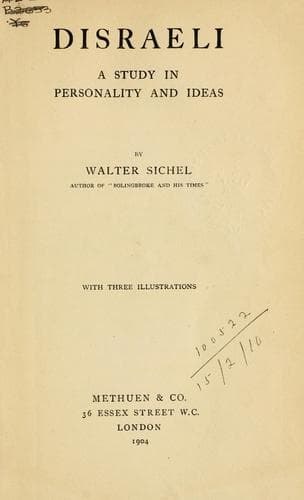
Disraeli: A Study in Personality and IdeasSichel, Walter
History
Disraeli: A Study in Personality and Ideas
Sichel, Walter
Disraeli, Benjamin, 1804-1881
Much, too, has been prattled about his “audacity,” and I notice that
the hackneyed quotation about “L’audace” is usually in these diatribes
ascribed to Danton, and not to its author, Beaumarchais. Many of these
“audacities” are now recognised as wisdom; but it has been after-wisdom
that has recognised it; though Disraeli was usually Prometheus.
“There are times,” he said in one of his early novels, “when I am
influenced by a species of what I may term happy audacity, for it
is a mixture of recklessness and self-confidence, which has a very
felicitous effect upon the animal spirits. At these moments I never
calculate consequences, yet everything seems to go right. I feel in
good fortune; the ludicrous side of everything occurs to me; I think
of nothing but grotesque images. I astonish people by bursting into
laughter apparently without a cause....”
Disraeli was naturally sensitive, but he studied self-repression. No
one was more cut to the quick by contumely or impertinence; no one was
more determined to hide the wound. “If,” once observed Jowett, “Dizzy
were on the brink of the bottomless pit, and each moment about to fall
into it, his look would never betray the fact; such is his pluck and
power of countenance.” As he bore himself towards provocation, he bore
himself towards pain. The last great speech he ever made was delivered
with youthful jauntiness, yet he was forced to take a drug in order to
deliver it. “One must meet death boldly,” he exclaimed to an intimate
friend, after he had read the denial of the doctors’ assurance in their
faces.
Disraeli’s intellectual shortcomings are those, it seems to me,
belonging to an intense, as opposed to a diffused imagination. His
mind shed both heat and light, but both the light and the heat were
over-concentrated. The same applies, perhaps, to his will, and to his
character also. Everything in him was focussed. His ideas possessed
him, and he chafed, like a sculptor at work, to embody them. Outside
the forms of those ideas he could not penetrate. In relation to them,
he judged all junctures and all endeavours. It is this averseness to
the abstract that pervades his every outlook. He could not conceive of
ideas as unmaterialised or disembodied. They had been the companions of
his boyish solitude.
“... The clustering of their beauty seemed an evidence of poetic
power: the management of these bright guests was an art of which I was
ignorant. I received them all, and found myself often writing only that
they might be accommodated.”
As a child, his ruling mood was that of reverie. He had steeped himself
in his father’s library, and his extraordinary imagination played upon
the poets, the philosophers, and, above all, the historians. Dim dreams
from the vast procession of the centuries took shape and became flesh.
He beheld the great men and movements marching before him. Incarnate
presences peopled his loneliness, and called to him with their voices--
Public-domain text, read in full here on John Shaqi.
Reviews
Reviews
No reviews yet
Be the first to share your thoughts on this work.
Elsewhere in the archive
Join the Discussion
Join the discussion
Sign in to leave a comment or review.
Sign InorCreate an account