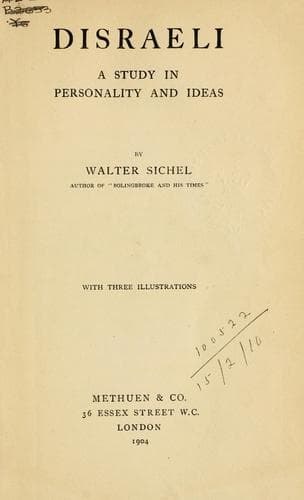
Disraeli: A Study in Personality and IdeasSichel, Walter
History
Disraeli: A Study in Personality and Ideas
Sichel, Walter
Disraeli, Benjamin, 1804-1881
In matters of courtesy he was old-fashioned and punctilious. To the
last he resented that grotesque disfigurement which was beginning to
make manners ugly before he died. Even at an earlier date, “Manners are
easy,” said “Coningsby,” “and life is hard.” “And I wish to see things
exactly the reverse,” said “Lord Henry,” “the modes of subsistence less
difficult, the conduct of life more ceremonious.”
In his fiction it was often objected that he over-depicted great
splendour and supreme beauty; that it was thronged with “daughters” and
mansions “of the gods.” But, if he erred in these respects, it was from
familiarity and not from ostentation, as Lady John Manners has pointed
out at some length. “It must be recollected,” she wrote, thinking of
_Lothair_, “that many of those who most appreciated him, and whose
friendship he warmly reciprocated, are surrounded in daily life by
a certain amount of state which employs their dependants.” So, too,
with regard to the peaceful and prosperous marriages of those homes of
forty years ago on which he delighted to dwell. He loved the gentle
Buckinghamshire landscape, with its treasures of association in every
cranny, more than all the remembered luxuriance of the South and glare
of the East. And it should also be remembered that his works abound in
sympathetic descriptions of all kinds and conditions of men, including
the strangest and humblest. They were taken from personal observation,
and he himself would penetrate the queerest haunts to gain the most
curious insight. The common and the uncommon people fascinated him, for
in them he found ideas; the middling charmed him less. He delighted to
invest the seemingly commonplace with significance, and also to strip
the pretentiously important of its wonder. Not even Dickens, as I shall
hint hereafter, knew or loved his London better. I shall also, in the
proper place, touch on the exotic element in his style and accent.
Mr. John Morley has aptly compared it to Goethe’s dictum about St.
Peter’s, that, though it is _baroque_; it is always the expression of
something great and not merely grandiose. His big words are never for
little things. Undoubtedly some of his earliest works are deficient in
taste; and there is a certain fierce hardness in their abrupt violence.
Mrs. Austin advised him in omissions from the original manuscript
of _Vivian Grey_; it was to women that he owed his training in these
directions. His knowledge was vast and profound, and he exercised the
habit of pursuing long trains of thought in reflection. He seldom
worked at night, preferring that season for brooding over his ideas.
But at all times, contrary to the superficial opinion, he worked long
and hard, sometimes over ten hours a day. His gift of divination never
dimmed his passion for study, until old age and ill-health warned
him that it must pause. He never ceased to deplore the want of “that
boundless leisure which we literary men need.” To the last, as Lord
Public-domain text, read in full here on John Shaqi.
Reviews
Reviews
No reviews yet
Be the first to share your thoughts on this work.
Join the Discussion
Join the discussion
Sign in to leave a comment or review.
Sign InorCreate an account