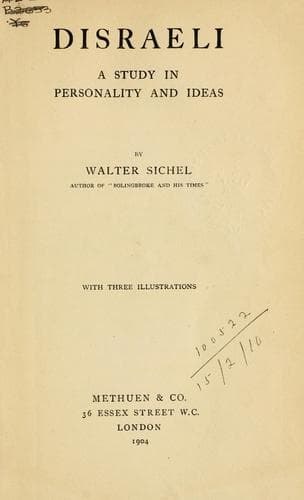
Disraeli: A Study in Personality and IdeasSichel, Walter
History
Disraeli: A Study in Personality and Ideas
Sichel, Walter
Disraeli, Benjamin, 1804-1881
[19] In _The Press_ (1853-59)--which vies with Swift in the _Examiner_
and Bolingbroke in the _Craftsman_, and to which Lord Derby and Shirley
Brooks also contributed--Disraeli finely characterises Chatham as “a
forest oak in a suburban garden.”
[20] Of this virtue, singled out with domestic purity by Gladstone for
praise in Disraeli, the late Lady J. Manners wrote, “He feared nobody
but God.” In my eighth chapter I shall quote Jowett’s verdict.
[21] “The Later Years of Lord Beaconsfield,” by Janetta, Lady J.
Manners, Blackwood, 1881.
[22] In 1852 he sought and obtained a long interview with Feargus
O’Connor, whose correspondence in the _Star_ he had utilised seven
years before in _Sybil_.
[23] “Thus, amid all the strange vicissitudes of life, we are ever, as
it were, moving in a circle.”
[24] In 1832.
[25] His Edinburgh speech of 1867 and his Glasgow address of 1873--on
“Representation” and “Equality” respectively rank among his best.
[26] So also does another. Lady Beaconsfield, waiting up, as was her
wont even in extreme age, for her husband’s return after a critical
effort, entered the library in the small hours of the morning (and in
_négligée_), and impetuously embraced what turned out to be Lord Cairns
writing an important minute before Disraeli’s arrival.
[27] When Lord Derby came in in 1852, “At last we have got a _status_,”
he said; “I feel like a young girl going to her first ball.”
[28] British Museum Add. MS. 34,645, f. 19.
[29] In _The Press_ Disraeli illustrates this historical fact with
infinite knowledge in a remarkable passage.
[30] In 1850, 1852, 1855, and 1859.
[31] Like most of the Peelites, Mr. Gladstone was not proof against
a certain air of over-righteous condescension and patronage. Even in
the ’sixties he notes in his diary that, meeting Disraeli at a time
of trial, he extended his hand, which was “kindly accepted.” But
he honestly admired his gifts, and in 1859 generously disdained to
“bargain” him “out of the saddle.”
[32] Not only convictions, but tactics also. Mr. Gladstone often blamed
actions in others which he afterwards adopted; Disraeli never did. I
subjoin a few instances. In 1852 he blamed Disraeli’s budget-proposal
for repealing half the malt tax; he himself afterwards repealed the
whole. In 1867 he blamed Disraeli’s first introduction of the Reform
Act by resolutions; next year he did the same with his Irish Church
Bill. In 1869 he severely blamed Disraeli for resigning without meeting
Parliament; in 1874 he himself followed suit.
[33] Some of the best in his earliest speeches are derived from “Don
Quixote.”
[34] Letters to the Whigs, _The Press_, May 7, 1853.
[35] Letters to the Whigs, _The Press_, May 14, 1853.
Public-domain text, read in full here on John Shaqi.
Reviews
Reviews
No reviews yet
Be the first to share your thoughts on this work.
Elsewhere in the archive
Join the Discussion
Join the discussion
Sign in to leave a comment or review.
Sign InorCreate an account