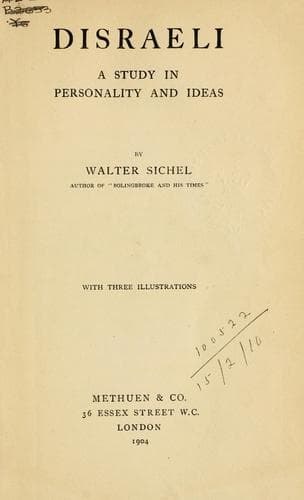
Disraeli: A Study in Personality and IdeasSichel, Walter
History
Disraeli: A Study in Personality and Ideas
Sichel, Walter
Disraeli, Benjamin, 1804-1881
[36] Disraeli always insisted on the indispensability of the party
system. As he pointed out of Bolingbroke, so in his own case, the
idea of a “national” party had to be accommodated to conservatism.
Gladstone, too, said of Peel, in 1846, that “to abjure party was
impossible” (Morley, i. 295; _cf._ Disraeli’s _Life of Lord George
Bentinck_, p. 224). After repeal was carried, Peel gave great offence
to his followers--and especially to Mr. Gladstone--by singling out its
illustrious and original champion for praise.
[37] “As for the Irish bill on which he had turned Peel out, it was one
of the worst of all coercion bills; Peel, with 117 followers, evidently
could not have carried on the Government, and what sense could there
have been in voting for a bad bill in order to retain in office an
impossible Ministry?”--He might have added that the bill--supported
some months earlier by Lord John and Lord G. Bentinck--under protest
as only excusable through urgency, was delayed by Peel to carry the
repeal, until its necessity had vanished.
[38] He said (1846): “... It was no wonder they (the Protectionists)
regarded themselves as betrayed, and unfortunately it had been the
fate of Sir R. Peel to perform the same operation twice.” From the
party standpoint there was abundant justification. Gladstone in old age
declared that “Disraeli’s brilliant philippics surpassed even their
reputation, and that, under their lash, Peel sat powerless.” _Cf._
Morley’s “Gladstone,” i. 296, iii. 465. “Dealt with them with a kind
of righteous dulness”--“The Protectionist secession due to three men.
Derby contributed prestige; Bentinck backbone; and Dizzy parliamentary
brains.” The real fault found with Disraeli by his enemies (but
afterwards) was that he “did not care a straw” for Protection. The
reader must judge after my two next chapters.
[39] It was a sail, however, that could not bear being crossed by
contrary winds. From youth upwards Gladstone could never brook
opposition.
[40] In 1831 Sir Henry Bulwer--_teste_ Mr. Frederick Greenwood--was
asked by his famous brother to meet his marvellous new friend at
dinner. The company was all young, ambitious, and able; yet all agreed
that their master was “the man in the green trousers.” Perhaps they
were not quite so green as Sir Henry’s recollection painted them.
[41] The title of “Beaconsfield,” long before foreshadowed in _Vivian
Grey_, was adopted in homage to the abode of Burke.
[42] This phrase was used by Disraeli in a speech of the ’fifties. Its
origin, though not its phrasing, is to be found in Bolingbroke.
[43] His conviction, however, that our Lord came to fulfil, not to
abolish, was directly derived from his father’s “Genius of Judaism.”
[44] I am informed, through the kindness of my friend Mr. George
Russell, that the original of “Theodora” was one Madame Mario, _née_
Jessie White.
[45] “Shelley and Lord Beaconsfield.” Blackwood, 1881. For private
circulation. Only twenty-five copies printed.
Public-domain text, read in full here on John Shaqi.
Reviews
Reviews
No reviews yet
Be the first to share your thoughts on this work.
Elsewhere in the archive
Join the Discussion
Join the discussion
Sign in to leave a comment or review.
Sign InorCreate an account