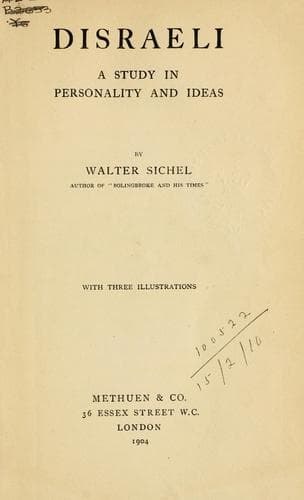
Disraeli: A Study in Personality and IdeasSichel, Walter
History
Disraeli: A Study in Personality and Ideas
Sichel, Walter
Disraeli, Benjamin, 1804-1881
[70] At that time, under the full spell of the analogy which the age
of Walpole presented, he believed that triennial parliaments and the
ballot might redress the balance of constitutional power and foil the
oligarchs who had baffled the people by espousing a popular cry. In
1852, however, he said, with regard to those proposals brought forward
by Mr. Hume: “... He did not object to them, but he saw no necessity
to adopt them. His objections to the latter were distinctly founded
on the limits of the franchise which the settlement of 1832 had not
sufficiently extended, but ... if they had universal suffrage they came
to a new constitution--a constitution commonly called the ‘Sovereignty
of the People,’ but that is not the Constitution of England; for,
wisely modified as that monarchy may be, the Constitution of England is
the sovereignty of Queen Victoria.”
[71] _Cf._ speech, May 18, 1871. The Whigs, who in 1843 called it “a
fungus of monopoly,” worked and upheld it afterwards as “Liberals.” Now
that a democracy and an Empire are being “run” at the same time, its
permanence, for many years questioned, seems assured.
[72] This preluded the “Lodger franchise,” of which, in 1867, Disraeli
said he had been “the father” (_cf._ p. 108).
[73] _Cf._ p. 109.
[74] This once more is emphasised by De Tocqueville as the essence of
centralisation.
[75] _Cf._ Morley’s “Gladstone,” vol. i. p. 262.
[76] _Cf._ the passage from _The Press_, cited _ante_, p. 7 note, and
_post_ at opening of Chapter VI.
[77] Bishop Latimer--quoted as motto to _Sybil_.
[78] Book iv. ch. iv.: “... To be a noble Master among noble Workers
will again be the first ambition with some few; to be a rich Master
only the second.”
[79] “Sidonia” stands for several types in addition to Disraeli’s own.
“Oswald Millbank” is in part painted from the young Gladstone. Most of
the other characters in _Coningsby_ are familiarly ascribed to their
originals.
[80] This phrase he twice repeats; the first time in that fine speech
at the Manchester Athenæum (1844), on the “Acquirement of Knowledge,”
which expressed his undying sympathy with the ideals, perplexities, and
possibilities of youth.
[81] This was the speech in which he said that Gladstone founded “a
great measure on a small precedent. He traces the steam-engine always
back to the tea-kettle.”
Public-domain text, read in full here on John Shaqi.
Reviews
Reviews
No reviews yet
Be the first to share your thoughts on this work.
Elsewhere in the archive
Join the Discussion
Join the discussion
Sign in to leave a comment or review.
Sign InorCreate an account