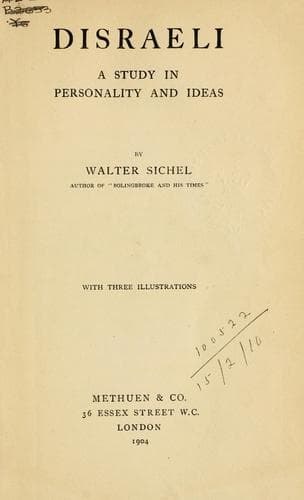
Disraeli: A Study in Personality and IdeasSichel, Walter
History
Disraeli: A Study in Personality and Ideas
Sichel, Walter
Disraeli, Benjamin, 1804-1881
[62] “... But thanks to parliamentary patriotism, the people of England
were saved from Ship-money, which money the wealthy paid, and only
got in its stead the customs and the excise, which the poor mainly
supply....”--_Sybil._
[63] “... Burke effected for the Whigs what Bolingbroke in a preceding
age had done for the Tories: he restored the moral existence of the
party. He taught them to recur to the ancient principles of their
connection.... He raised the tone of their public discourse; he
breathed a high spirit into their public acts....”--_Ibid._
[64] “... In my time” (said Mr. Ormsby) “... a proper majority was a
third of the House. That was Lord Liverpool’s majority. Lord Monmouth
used to say that there were ten families in this country who, if they
could only agree, could always share the government. Ah! those were the
good old times!...”
[65] That this object was of direct design is proved by a
correspondence of Cobden with Sir Robert Peel.
[66] In a speech of 1864, Disraeli said: “... For my own part,
believing that parliamentary government is practically impossible
without two organised parties, that without them it would be the most
contemptible and corrupt system which could be devised, I always regret
anything that may damage the just influence of either of the great
parties in the State.”
[67] The great depression of 1847-51 was not wholly caused by the
fiscal change. It was largely due to reaction after the railway mania,
as Disraeli pointed out in a speech of 1879. It was followed by a rise
in wages, due, not to Free Trade, but to the large imports of newly
discovered gold; and by an increased purchasing power which _was_ due
to Peel’s large abatements of the tariff.
[68] It should be borne in mind that Disraeli sometimes employs the
words “aristocracy” and “democracy” to mean the order of aristocrats
and democrats, sometimes to mean the systems of exclusion and
inclusion, sometimes to mean the government by the best and by the
miscellaneous, and oftener as indicating elements in our Constitution.
[69] This phrase is American, and refers to the democrat extremists,
conduct in Tammany Hall in 1834. The same year had seen the invention
of the “self-lighting” cigar.
Public-domain text, read in full here on John Shaqi.
Reviews
Reviews
No reviews yet
Be the first to share your thoughts on this work.
Elsewhere in the archive
Join the Discussion
Join the discussion
Sign in to leave a comment or review.
Sign InorCreate an account