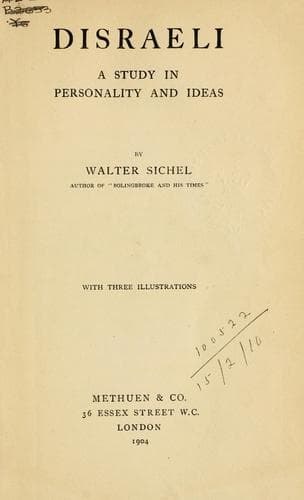
Disraeli: A Study in Personality and IdeasSichel, Walter
History
Disraeli: A Study in Personality and Ideas
Sichel, Walter
Disraeli, Benjamin, 1804-1881
[101] This idea is, among other speeches, worked out in that delivered
at Amersham, December 4, 1860, where he says: “The parish is one of
the strongest securities for local government, and on local government
mainly depends our political liberty.” He points out that the Church is
not oligarchical, and does not claim those exclusive privileges which
the Nonconformists often do. It is national in its comprehensive ties
with the country and its inclusiveness. The abolition of the parish
system would alone prove a national and social upheaval.
[102] This policy was pressed by Peel in the early ’forties, and led to
the fine work of the National Schools.
[103] That of Strauss.
[104] In the Croker Papers will be found a masterly letter from Sir
Robert Peel on the importance of the Church rising to her educational
opportunities. It was Peel’s foresight that produced the National
Schools. Peel, though latitudinarian, was a Church statesman.
[105] I may add that what Disraeli resented in Gladstone’s thwarted
proposals for his Catholic University scheme was that it sought
to exclude theology and philosophy--an exception unworthy of any
“Universitas rerum,” and deeply repugnant to the Catholics.
[106] Letter to D. O’Connell, 1835.
[107] This has been elaborately developed by Bolingbroke in his
“Philosophical Works.”
[108] How true this has now proved itself in France!
[109] Elsewhere Disraeli said that Paris always remains a republic.
[110] It will be noticed that Sir Robert goes beyond Disraeli’s ideas
of direct kingship.
[111] In 1872, Disraeli said, after stating that Lord Derby’s successor
was no enemy to Russian aggression, “... I speak of what I know, not
of what I believe, but of what I have evidence in my possession to
prove, _that the Crimean War would never have happened if Lord Derby
had remained in office_....” Lord Derby’s error in resigning in 1853
he always deplored; just as he regretted equally his rash acceptance
of office during the previous year, and his more fatal timidity in
shrinking from assuming it in 1855.
[112] This passage was written before the events of 1903.
[113] This was realised some ten years later by the repeal of the Sugar
Duties.
[114] The speech about Income Tax, which contains another masterly
analysis of the displacement of labour. Previously, in 1845, he
had said of Canada, “... I am not one of those who think that its
inevitable lot is to become annexed to the United States. Canada has
all the elements of a great and independent country, and is destined, I
sometimes believe, to be the Russia of the New World.”
[115] “Ἀλλ’ οὐκ ἀπολώλεκ’ ἀλλὰ καταπεφρόντικα.”
[116] It will be remembered that in _Coningsby_ “Rigby’s” election
speech called everything with which he disagreed “un-English.”
Dickens’s satire of the misuse of “un-English” in the person of
“Podsnap” may be compared.
Public-domain text, read in full here on John Shaqi.
Reviews
Reviews
No reviews yet
Be the first to share your thoughts on this work.
Elsewhere in the archive
Join the Discussion
Join the discussion
Sign in to leave a comment or review.
Sign InorCreate an account