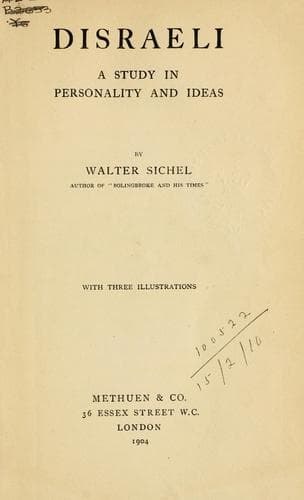
Disraeli: A Study in Personality and IdeasSichel, Walter
History
Disraeli: A Study in Personality and Ideas
Sichel, Walter
Disraeli, Benjamin, 1804-1881
[117] “Light and leading,” which Disraeli employed long before the
famous letter to the Lord-Lieutenant of Ireland, in a speech of 1858,
comes of course from Burke. His theory of the House of Lords in 1861 as
“an intermediate body” is derived from Bolingbroke and Burke. “Peace
with honour” he employed in one of his Crimean speeches. Many of his
phrases were derived from the works of his father.
[118] He had in an earlier speech considered this question with regard
to Canada.
[119] This very phrase was repeated by Lord Beaconsfield in 1876.
[120] This point is admirably elucidated by Mr. Ewald in his “Life and
Times of Lord Beaconsfield.”
[121] Chiefly that of the Turkish frontier in Europe, and of the
Russian in Asia.
[122] A most interesting collection might be made of Disraeli’s ready
and fluent illustration by precedents. For of precedent his memory was
quite as retentive as Gladstone’s. In his famous Address to the Crown
of 1864, he was sharply blamed for referring to “the just influence
of England being lowered” in the extraordinary tangle of alternate
brag and whimper that attended the Government’s action in the Danish
embroilment. This language was solemnly declared “unprecedented since
the great days of the Norths and the Foxes.” But Disraeli instantly
proved that Fox himself had used language in his own Address far more
violent and censorious of the Ministry in 1846. So, again, on at least
two occasions when the phrases “political morality” and “political
infamy” were bandied for partisan purposes, he effectively hurled
back the taunts in the teeth of their inventors, and refuted present
profession by past conduct. When Palmerston again twitted him, in 1846,
he received a reminder which brought home the jaunty service of seven
successive Administrations, and all this, though he never attacked
small game, and never any “unless he had been first assailed.” In the
earlier numbers of _The Press_ are many most interesting historical
instances of how “principles” may be confused with “measures,” when
the latter have to be relinquished in office from the practical duty
of _carrying on the Government_, while at the same time the former can
be developed in other directions when the national condemnation of the
particular measure is deliberate. So Fox had acted towards Catholic
emancipation, Russell towards the Appropriation Bill, the Whigs in
the ’forties towards the Income Tax, and Disraeli in 1852 towards
“Protection.” So, he argued in many previous utterances, the principle
must now be followed by relieving the land, now placed under unfair
conditions of competition, of its burdens.
[123] Of Disraeli’s Indian policy this much may here be noted. While
allowing Russia to expand where she was entitled or compelled by war,
or allowed by opening intrigues, he wished to baffle her as against
Great Britain.
(1) By an independent Afghanistan, with a proper frontier and its
Indian “gates” barred.
Public-domain text, read in full here on John Shaqi.
Reviews
Reviews
No reviews yet
Be the first to share your thoughts on this work.
Elsewhere in the archive
Join the Discussion
Join the discussion
Sign in to leave a comment or review.
Sign InorCreate an account