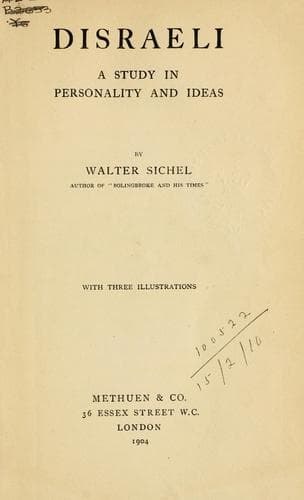
Disraeli: A Study in Personality and IdeasSichel, Walter
History
Disraeli: A Study in Personality and Ideas
Sichel, Walter
Disraeli, Benjamin, 1804-1881
Disraeli, Benjamin, Earl of Beaconsfield [and _see_ Carlyle,
Colonies, Empire, Reform Bill, America, Ireland, and Foreign
Policy], his idea of Conservatism, 5-8, 39, 204;
a poet and artist, 11, 36;
his early surroundings, 16-18, 268-272;
unique phases of earliest youth, 16, 18, 275, 309-312, 321-325;
distinction between wish for influence and for position, 12;
his mission, 5-7, 12, 49-52, 56, 111, 119, 210;
regrets Lord Derby’s temerity then, as much as his timidity in the
_gran’ rifuto_ of 1855 ... 191, _n._, 213, _n._;
indisposition to take office, 1852 ... 14;
never opportunist: courted unpopularity, _ib._;
“national” attitude, 19, 47, 48, 49, 55, 56, 66, 68, 84,
191, _n._, 210;
responsibility and privilege, 7, 13, 95, 98, 107, 144, 210;
utterances to be viewed successively, 20;
described in youth, 22-25;
described in age, 25-27;
debt, 24, 281-282;
gambling, 282;
contradictions in, 46, 47;
reconciliation of, 43, 293;
illness, 23, 311, 324, 325;
love of flowers and forestry, 26;
light and books, _ib._;
influence with Queen, 29;
and art, 19, 30;
manners, 31;
love of London, 31, 307-308;
vigilance, 32, 246;
generosity, 34, 35;
contrasted with Gladstone, 35-42;
scholarship, 36;
love of beauty, 17;
his longsighted plan, 39;
land, labour, democracy, and empire, _ib._;
principles and measures, _ib._;
duties of opposition, 40;
wish for strong government, _ib._, 42, 50, 210, 252;
dislike of bores, 40, 44, 224;
“nationality and race,” 45, 225;
“detachment,” 46;
influence of eighteenth century on, _ib._;
“predisposition,” _ib._;
religious ideas, _ib._;
“feudal and federal principles,” 51, 63;
change and “obsolete opinions,” 51, 81;
French Revolution theories, 58-68, 83, 85, 97, 145;
historical outlook, 73-77, 81-83;
revolutions, 47, 72;
republican plots, 77;
dread of plutocracy, 6, _n._ 3, 77, 111, 115, 129, 202;
universal suffrage, 77-80, 98-104;
gentlemen should prove leaders, 80;
conduct in 1852 ... 39, 40;
store set by landed interest, 68, 71, 86, 95, 114, 135;
languages, 241;
classics, 249;
middle classes, 83, 105, 123-124, 134-135, 251;
efficacy of Parliament (1848), 87;
his principles of representation, 94;
taxation and, 94;
income-tax and middle class, 96;
views prophecies as to social effects of Peel’s changes, 97;
uniform wish throughout for industrial franchise, 98 _et seq._;
“free aristocracy,” 49, 98, 118, 119;
adopted rating principle of Russell in 1854 ... 100;
the consistent train which led to his measure of 1867, 99-101;
counties and boroughs, 100, 104;
wanted democracy as an element, not a class, 101;
“population” and property standards, 101-104;
wish for variety in representation, 98, 104;
discontent and disaffection, 106;
Public-domain text, read in full here on John Shaqi.
Reviews
Reviews
No reviews yet
Be the first to share your thoughts on this work.
Elsewhere in the archive
Join the Discussion
Join the discussion
Sign in to leave a comment or review.
Sign InorCreate an account