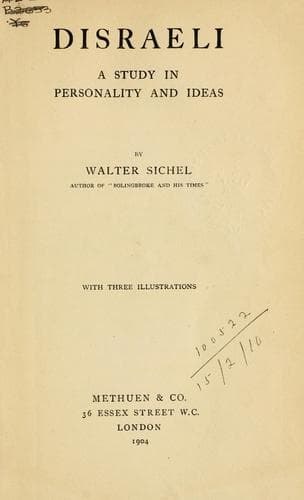
Disraeli: A Study in Personality and IdeasSichel, Walter
History
Disraeli: A Study in Personality and Ideas
Sichel, Walter
Disraeli, Benjamin, 1804-1881
summary of his ideal for making Toryism “national,” 107;
“household democracy,” 109;
Disraeli’s long consistency, 108-110;
lifelong attitude to Labour, 112-129;
problems of 1830-40 ... 113;
Disraeli’s social outlook on “condition of England” and economical
problems, 114 _et seq._;
upshot of his sympathy with labour (_q.v._), 116 _et seq._, 118,
119;
vision of a vanishing industrialism, 119;
the spirit of chivalry applicable to labour, 122;
“saviours of society,” 122;
and “Anglicanism,” 126;
he breaks up “Young England” (1845) by pressing home their Church
convictions, 128;
parochial life more important even than political, 127;
his views of “Free Trade” (_q.v._), 131-142;
influence on prices and wages of precious metals, 131,
_n._ 1, 133, 140;
“Reciprocity,” 129, 131, 138, 140;
attitude on Corn Laws, 131-135;
distribution of labour and purchasing power, 113, 131;
Disraeli’s probable attitude towards Mr. Chamberlain’s present
fiscal scheme adumbrated: wholesale plans, retail
applications, 135-141;
consumer and producer, 136;
social, political, spiritual aspects of _Church_ (_q.v._) viewed
from Disraeli’s theocratic bias, 145-179;
Puritanism and Theocracy, 149, 151;
and Ireland, 200;
Aryan and Semitic conceptions, 145 _et seq._;
Anglican Church “part of England,” “one of the few great
things left,” 153;
society, inconceivable without religion, 155;
part played by this attitude in his novels, 155-156;
and science, 156-159;
and revelation by races, 157, _n._ 1;
materialism, 158;
Disraeli’s beliefs, _ib._, 155;
State would lose by severance, 159-163;
“Atheism in domino,” 166;
“Man in masquerade,” 170;
not a “mystic,” 156;
attitude on education (_q.v._), 167-169;
discipline, 169, 170;
universities, 169;
his bias for _Monarchy_, 180-184;
and royal prerogative, 184, 189-192, and fully the whole of Ch. V.;
Royal Titles Bill, 193-194;
cheapness of monarchy, 192;
debt to Bolingbroke’s ideas, 195-198
_Colonies_ (_q.v._), Disraeli’s zeal and plans for, 198;
Disraeli’s attitude to “millstone” view investigated, 200-203;
“Peace at any price,” 207;
“timidity of capital,” 202;
power of instancing political precedent, 213, _n._ 1;
origin of his title, 44, _n._
_Empire_ (_q.v._ and _Foreign Policy_), temper of his imperialism,
209 _et seq._, 245;
principles of his policy illustrated, 210-214, 217-221;
Eastern policy considered, discussed, and illustrated, 222-236;
“the just influence of England,” 235;
diplomacy, 221-222;
Cyprus, 230;
his attitude to France (_q.v._), 235-239;
Germany (_q.v._), 240;
Austria and Italy (_q.v._), 241-243;
Poland, Greece (_q.v._), 243;
pronouncement on militarism with constitutional _forms_, 244;
Public-domain text, read in full here on John Shaqi.
Reviews
Reviews
No reviews yet
Be the first to share your thoughts on this work.
Elsewhere in the archive
Join the Discussion
Join the discussion
Sign in to leave a comment or review.
Sign InorCreate an account