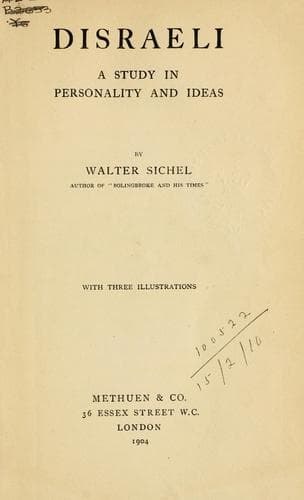
Disraeli: A Study in Personality and IdeasSichel, Walter
History
Disraeli: A Study in Personality and Ideas
Sichel, Walter
Disraeli, Benjamin, 1804-1881
“As it is not the interest of the rich and the powerful to pursue
popular principles of government, the wisdom of great men and the
experience of ages have taken care that these principles should be
cherished and perpetuated in the form of institutions. Thus the majesty
that guards the multitude is embodied in a throne; the faith that
consoles them hovers round the altar of a national Church; the spirit
of discussion, which is the root of public liberty, flourishes in the
atmosphere of a free Parliament.”
These, in the rough, are some of Disraeli’s ideas as to the new
democracy. From the first, as we shall see, he compassed the renewal
of the English democratic idea--that of democracy as an _element_--in
opposition alike to the State tutelage of the French, and to that
form of democracy which means the undue power of one _class_ in the
nation. His Reform Bill of 1867 was the accomplishment of his earliest
hopes, and the realisation of principles distinct from the spasms of
doctrinaire “Liberalism.”
He regarded our Constitution--the quintessence of the English character
immanent in English institutions--as a real though limited monarchy,
tempered by a democracy which is in effect neither more nor less than
_a natural aristocracy_.
“Aristocracy,” as a universal principle and not the badge of a
particular class, is the committal of political privilege far more
to representative influence than to powerful interests. A “natural”
aristocracy must comprehend and absorb the superiors of every class in
all their varieties.
Public-domain text, read in full here on John Shaqi.
Reviews
Reviews
No reviews yet
Be the first to share your thoughts on this work.
Elsewhere in the archive
Join the Discussion
Join the discussion
Sign in to leave a comment or review.
Sign InorCreate an account