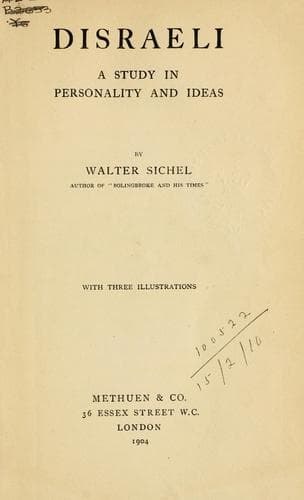
Disraeli: A Study in Personality and IdeasSichel, Walter
History
Disraeli: A Study in Personality and Ideas
Sichel, Walter
Disraeli, Benjamin, 1804-1881
“The Monarchy of the Tories,” Disraeli exclaimed in his youth,[54]
“is more democratic than the Republic of the Whigs.” “The House of
Commons,” he exclaimed many years later, “is a more aristocratic
body than the House of Lords.” In each House, through all its
pronouncements, he recognised that the democratic element is
aristocratic, the aristocratic element democratic. That the
representative assembly of the Commons, which is elected, should
include all that is best from each class which by its qualities has
earned the boon of the franchise; that the representative assembly,
which is not elected, should include more and more not only those whose
aggrandisement stands for the interests of property, but those too
whose intellect and attainments entitle them to distinction. Nor, of
course, can the fact be ignored that through hereditary honours the
Estate of the Commons, which constantly reinforces the Estate of the
Peers, is, in its turn, as constantly refreshed from the Estate of
the Peers. And from first to last, in theory, as well as in action, he
upheld the land as the deepest foundation of England’s greatness of
character. I could quote passage after passage, both from books and
speeches, and regarding subjects the most various, in which he presses
home the substantial importance of a territorial constitution, and the
fact that the landed interest is in truth not only a safeguard for
freedom in peace and vigour in war, but also an industrial interest of
the highest order; and doubly so, because by sentiment, by tradition,
by its contribution to local government, to stability, to the social
scale of duties conditioning the tenure of property, to physique, its
influence is essential and exceptional. I shall content myself with
a citation from a speech of 1860, and it may be remembered that the
acute De Tocqueville singles out the self-seclusion of the official
bourgeoisie from the land as a chief contributory to the French
Revolution--
“... I look round upon Europe at the present moment, and I see no
country of any importance in which political liberty can be said to
exist. I attribute the creation and maintenance of our liberties to
the influence of the land, and to our tenure of land. In England
there are large properties round which men can rally, _and that in my
mind forms the only security in an old European country against that
centralised form of government which has prevailed, and must prevail,
in every European country where there is no such counterpoise_. It is
our tenure of land to which we are indebted for our public liberties,
because it is the tenure of land which makes local government a fact in
England, and which allows the great body of Englishmen to be ruled by
traditionary influence and by habit, instead of being governed, as in
other countries, by mere police.”
Public-domain text, read in full here on John Shaqi.
Reviews
Reviews
No reviews yet
Be the first to share your thoughts on this work.
Elsewhere in the archive
Join the Discussion
Join the discussion
Sign in to leave a comment or review.
Sign InorCreate an account