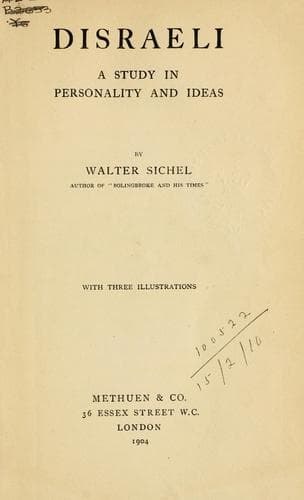
Disraeli: A Study in Personality and IdeasSichel, Walter
History
Disraeli: A Study in Personality and Ideas
Sichel, Walter
Disraeli, Benjamin, 1804-1881
Disraeli was always staunch to the land. After the Corn Law repeal,
he strove pertinaciously till he succeeded in removing those especial
burdens which unfairly hampered their free competition, and which were
originally the price of peculiar privileges then removed. But though
he always desired a preponderance of the various landed interests, he
never wished for their predominance. And to the last he refused to
allow any spurious cry for especial measures on their behalf to be
raised when a temporary depression due to the seasons arose, which
he always distinguished from permanent causes connected with social
revolutions.[55]
To develop our ancient institutions was his lifelong specific. From
his earliest pronouncements, those in the _Letter to Lord Lyndhurst_,
those in _What is he?_ and in _Gallomania_, those in the _Spirit
of Whiggism_, those in his first election speeches, extending over
a period of five years before he was returned, in his three first
political novels, to his latest orations on Conservatism as a
“national” cause, he laid the greatest stress on the function and
origin of the three co-ordinate Estates of the Realm--“popular classes
established into political orders”[56]--which under monarchy form our
Constitution. And, while to the end he praised that mighty force of
public opinion which has in the person of the Press almost divested
Parliament of its ancestral office as “the grand inquest” of national
grievances, he still held the “organisation of opinion” to remain
the essence of the party system; while he increasingly desired the
presence in Parliament of elements at once various and choice,[57] and
the absence from its councils of any preponderant sects or sections.
Like Burke, he believed that Parliament should be under every changing
phase of national development “the express image of the feelings of
the nation;” like Bolingbroke, he deemed that it should be also the
collective assemblage of its wisdom. He regarded these “estates” as the
embodiment of great national interests organised on the principle of
distinct duties conditioning privilege; and he desired that, however
modified, they should never be altered so as to impair the great
national institutions as whose buttresses they were built to serve.
Public-domain text, read in full here on John Shaqi.
Reviews
Reviews
No reviews yet
Be the first to share your thoughts on this work.
Elsewhere in the archive
Join the Discussion
Join the discussion
Sign in to leave a comment or review.
Sign InorCreate an account