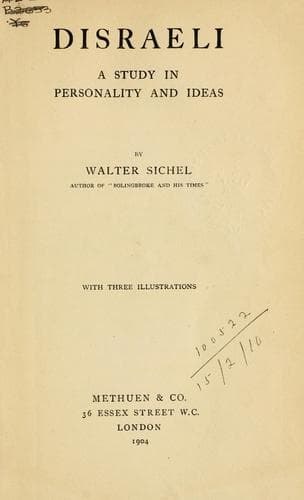
Disraeli: A Study in Personality and IdeasSichel, Walter
History
Disraeli: A Study in Personality and Ideas
Sichel, Walter
Disraeli, Benjamin, 1804-1881
Looking back historically, he discerned that some hundred and twenty
years before the birth of English Liberalism, a country and “Old
England” party, perplexed by dynastic and economic problems, confronted
too by the semi-scientific rationalism of a new age, had been first
schooled into comprehensive, generous, and “national” aspirations by
a great but lost leader, and had then been baffled by a set of great
families. Most of these began by professing Republican principles,
and all of them were branded in the literature of Queen Anne as the
“Venetian oligarchy.” These families aimed steadily for more than
a century at engrossing the whole power of the State. Their bias
from 1700 to Sunderland’s peerage bill in 1718, and from 1718 to the
Reform Bill of 1831 remained Republican. But so long as a king was
content to be a puppet dancing on their wires, and the nation to be
cowed into lethargy, they could dispense with theoretical forms,
mainly upheld as a ladder towards oligarchical power. From time to
time they assumed popular causes, but somehow they never succeeded
in themselves being popular, because their chief object as a party
organisation was “the establishment of an oligarchical government
by virtue of a Republican cry;”[58] because, as Disraeli has again
shown, English revolutions have always been in favour of privilege
traditionally distributed, while foreign revolutions have been against
all privilege whatever; because the “New Whigs” of Queen Anne and the
first two Georges sought a _tabula rasa_--a plain map, as opposed
to the picture with perspective of English institutions. They were
theoretically for “liberty and property”--the “_New_ Whig” catchword
of Queen Anne’s reign that replaced the old one of “Liberty” alone, in
which both Whigs and Tories joined at the revolution--but their bias
was always more for property than for liberty. They sought to amass
money and power through the amassing classes. They never studied the
varied interests of the whole nation. Walpole usurped their place, but
retained their influence, and by his virtue George I. reigned rather
than ruled over the towns instead of over the country. At first these
oligarchs kicked against the growing management of a sole minister,
but the shrewd steadiness of a superior will overmastered them, and
Newcastle remained on Walpole’s side--the insignificant representative
of their tamed confederacy. Trade ceased to follow the land, but
tended more and more to acquire it by purchase, until a fresh moneyed
oligarchy, which acquired fresh titles, was formed. The great Chatham
broke it for a time; and afterwards George III. obstinately mutinied
against its shackles. The French overthrow transformed the Whig cry of
Republicanism to the Whig cry of Jacobinism. “... Between the advent of
Mr. Pitt and the resurrection of Lord Grey, ... ever on the watch for a
cry to carry them into power, they mistook the yell of Jacobinism for
Public-domain text, read in full here on John Shaqi.
Reviews
Reviews
No reviews yet
Be the first to share your thoughts on this work.
Elsewhere in the archive
Join the Discussion
Join the discussion
Sign in to leave a comment or review.
Sign InorCreate an account